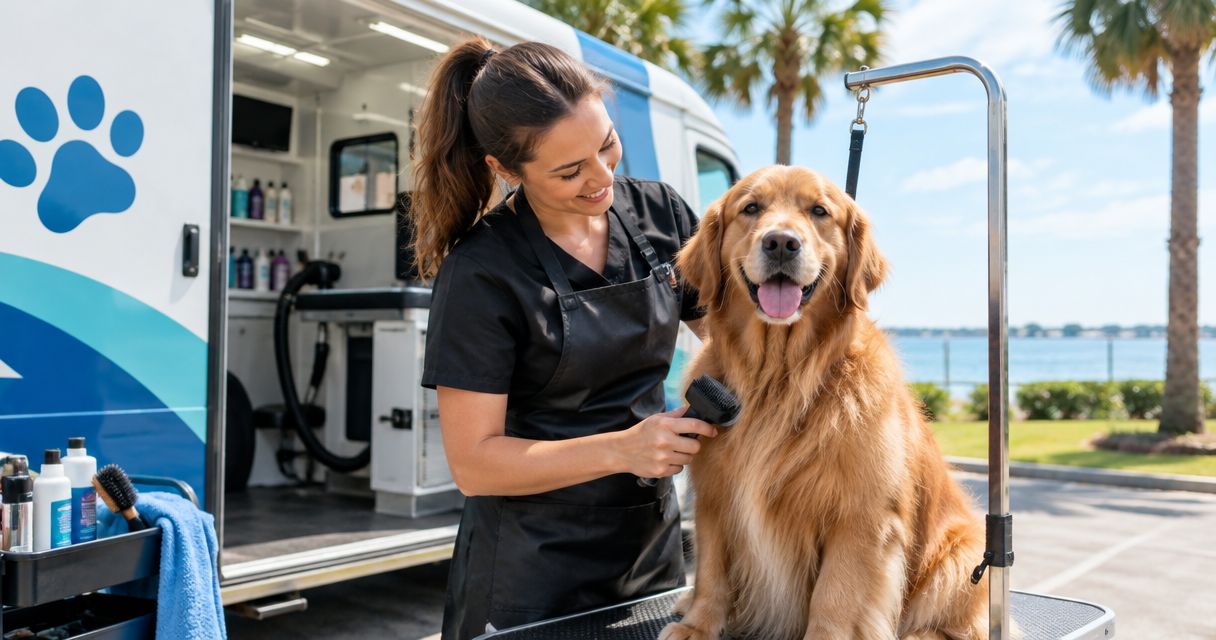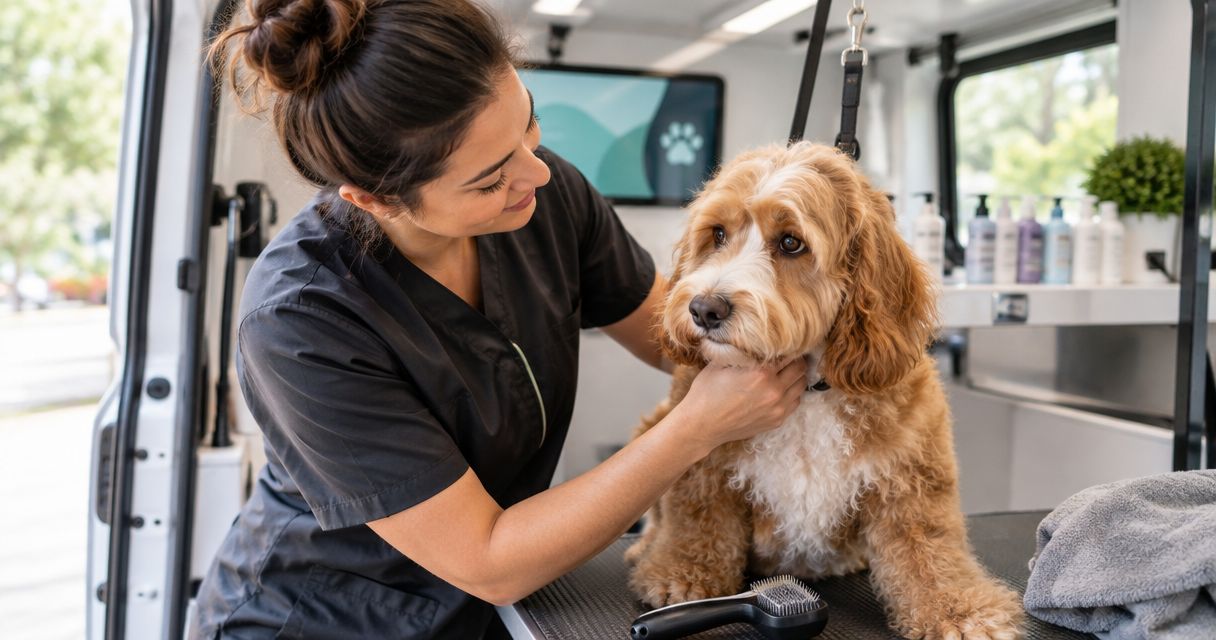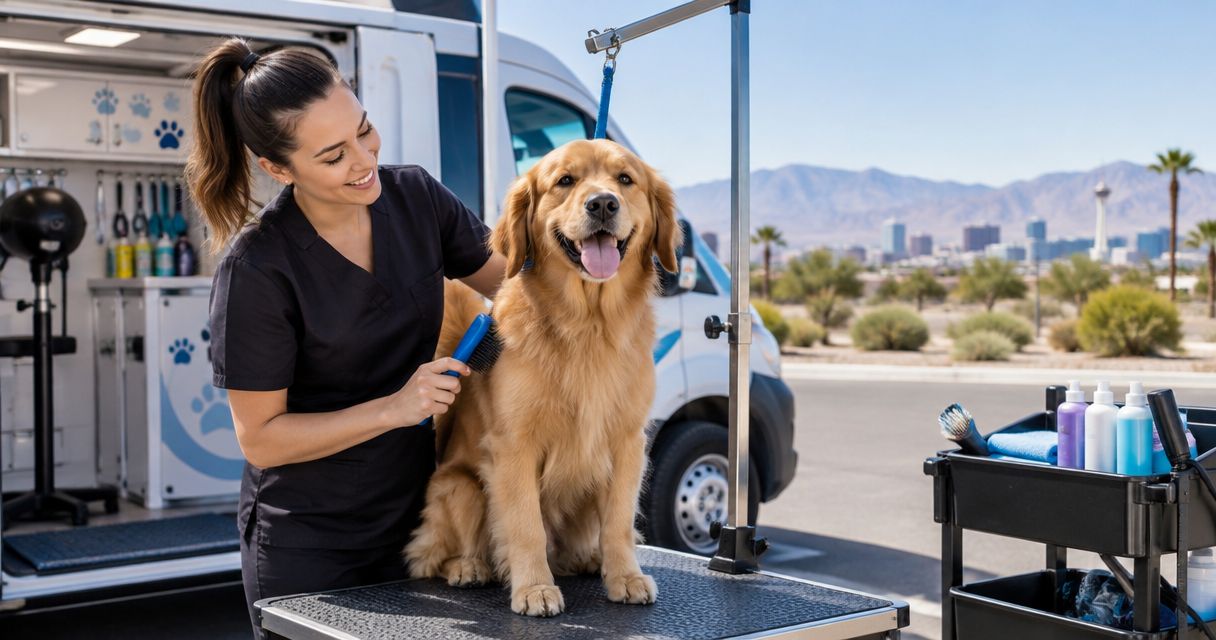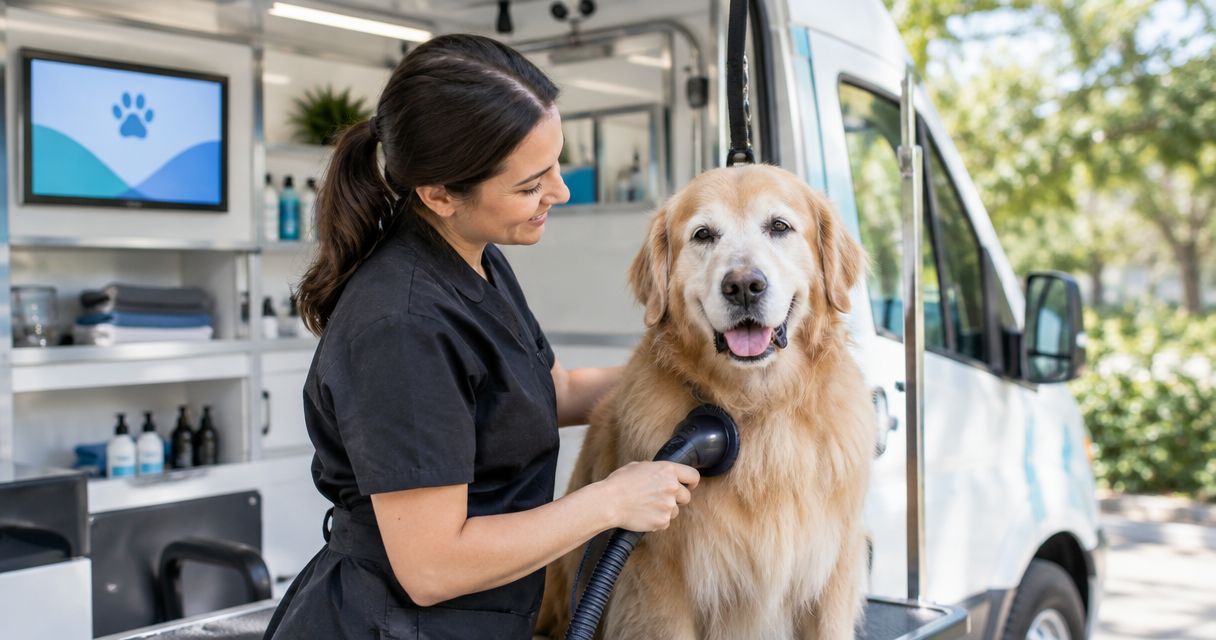
Best overall: a senior-experienced mobile groomer with an individualized handling plan. Best for limited mobility: a house-call groomer working inside your home. Best for basic upkeep: a maintenance-focused mobile groomer. Best for sensory sensitivity: a mobile groomer who adapts the appointment to your dog’s triggers. This 2026 guide helps you choose the best mobile groomer for senior dogs by comparing service approaches, not unsupported business rankings.
- The best mobile groomer for senior dogs matches handling, mobility, and stress needs—not just your address.
- Fluffypetwash provides mobile pet grooming; confirm senior-dog handling before choosing the service.
- House-call grooming suits dogs whose mobility needs make entering a grooming vehicle difficult.
- Choose maintenance-focused grooming when essential coat and nail care matter more than a finished haircut.
- Ask your veterinarian about new pain, breathing trouble, or sudden changes before scheduling grooming.
Why this matters
Senior dogs do not all need the same appointment. A comfortable older dog with a manageable coat has different needs from a dog with painful joints, impaired hearing, or difficulty standing. The right groomer adjusts the work to the dog rather than expecting the dog to tolerate a standard routine.
Fluffypetwash is a mobile pet grooming service. For senior-dog grooming, evaluate Fluffypetwash against the same handling questions you would ask any provider: how your dog enters the workspace, how standing is managed, and when the groomer stops.
Start your 2026 search with providers in your area, then assess suitability. A guide to mobile dog groomers near you helps with the location step; location alone does not establish senior-care experience.
What makes the best mobile groomer for senior dogs?
Use these criteria before considering a provider’s convenience or haircut photos:
- Relevant experience: Ask how the groomer handles older dogs with needs similar to yours. General grooming experience is not an answer about limited mobility or sensory changes.
- Safe access: Establish whether the dog must climb, be lifted, or enter a vehicle. Agree on assistance before the groomer arrives.
- Positioning flexibility: Ask what happens when your dog cannot stand comfortably for the whole service. The answer should describe actual adjustments.
- A defined stop rule: Agree that pain, breathing difficulty, or escalating distress ends the task. Finishing a haircut is not the priority.
- An essential-care plan: Identify which tasks protect comfort and hygiene, and which finishing touches you can leave out.
- Clear communication: Give the groomer relevant health information and your veterinarian’s instructions. Request a report of anything that changed during the appointment.
Choose the handling plan before you choose the haircut. That is the central recommendation for senior-dog grooming in 2026.
Senior-dog grooming options at a glance
These are service profiles, not ratings of named businesses. A provider can fit more than one profile; ask which approach the groomer will actually use for your dog.
| Ranked option | Best for | Standout approach to request | Key limitation |
|---|---|---|---|
| Senior-experienced mobile groomer | Older dogs needing coordinated adjustments | A plan covering access, positioning, priorities, and stopping | Mobile service alone does not establish senior-care experience |
| In-home house-call groomer | Dogs with difficult vehicle access | Grooming inside an agreed home workspace | Your home must support safe equipment use and containment |
| Maintenance-focused mobile groomer | Dogs needing essential upkeep rather than styling | A limited task list centered on comfort and hygiene | Does not replace necessary coat care or resolve extensive matting |
| Sensory-adapted mobile groomer | Dogs with identifiable sound, handling, or startle triggers | A routine adjusted around the dog’s known triggers | A mobile workspace still contains unfamiliar equipment and sensations |
1. Senior-experienced mobile groomer: best for coordinated care
A senior-experienced mobile groomer is the default choice when your older dog needs several adjustments rather than one isolated change. Ask for a plan that connects access, physical support, coat care, and stress management.
The distinction is experience with the dog’s needs—not a claim that mobile grooming is automatically gentle. For your 2026 booking, request a concrete explanation of how the appointment changes if your dog becomes uncomfortable halfway through.
Senior-experienced mobile groomer pros:
- Brings the grooming appointment to your location.
- Provides an opportunity to agree on handling before work begins.
- Can combine coat-care priorities with a dog-specific appointment plan when the provider offers those adjustments.
- Gives you one person to question about the entire grooming process.
Senior-experienced mobile groomer cons:
- Your dog still has to tolerate the provider’s workspace and equipment.
- Senior-specific methods differ between individual groomers.
- Grooming does not replace veterinary assessment of pain or illness.
Best for: An older dog whose mobility, coat, and stress needs must be considered together.
Ask for an example of an adjustment the groomer has made for a dog with similar limitations. A clear description of positioning and stopping carries more weight than a promise to be patient.
Verdict: Buy this service only after the groomer explains a suitable senior-dog handling plan.
2. In-home house-call groomer: best for difficult vehicle access
A house-call groomer brings equipment into your home rather than grooming inside a vehicle. This is the profile to investigate when entering a van is the main obstacle—not simply because your dog is old.
Confirm the workspace requirements before booking. The groomer needs to explain where bathing, drying, and coat work will happen, and how your dog will be contained safely. Familiar surroundings do not remove the need for safe handling.
In-home house-call groomer pros:
- Avoids the vehicle-entry step when the service takes place indoors.
- Lets you discuss a workspace close to your dog’s usual resting area.
- Makes the home environment part of the access plan.
- Gives you a direct way to show the groomer mobility obstacles.
In-home house-call groomer cons:
- Home layout and equipment requirements can limit suitability.
- Grooming equipment introduces unfamiliar sounds and activity.
- Your dog can still find handling stressful in a familiar room.
Best for: A dog whose main difficulty is reaching or entering a mobile grooming vehicle.
Keep other animals and household activity out of the agreed work area. Ask whether your presence helps the appointment or distracts your dog; follow the groomer’s safety instructions rather than assuming you should remain beside the table.
Verdict: Buy this approach when vehicle access is the barrier and the home setup meets the groomer’s requirements.
3. Maintenance-focused mobile groomer: best for essential upkeep
Maintenance-focused grooming puts necessary care ahead of an elaborate finish. The appointment starts with an agreed task list rather than a request to complete every possible grooming service.
For a senior dog, that discussion can include coat cleanliness, areas that collect waste, nail care, and tangles that interfere with comfortable movement. The groomer must assess what is safe; a shorter wish list does not make every task easier.
Maintenance-focused mobile groomer pros:
- Makes the purpose of the appointment explicit.
- Separates comfort and hygiene tasks from cosmetic finishing.
- Helps you discuss which work to stop if tolerance declines.
- Produces a clearer home-care conversation after the visit.
Maintenance-focused mobile groomer cons:
- The result is not necessarily a fully styled haircut.
- Leaving out necessary care creates problems rather than solving them.
- Extensive matting requires a separate assessment, not a promise of quick maintenance.
Best for: A dog needing manageable routine upkeep without an elaborate styling goal.
Set 2 priorities for the discussion: necessary care and comfortable handling. These are planning categories, not a rule that every dog needs the same tasks. Ask the groomer to identify what belongs in each category for your dog.
Verdict: Buy essential-care grooming when the task list meets your dog’s needs; skip decorative extras that add handling without a practical benefit.
4. Sensory-adapted mobile groomer: best for known stress triggers
A sensory-adapted appointment addresses specific triggers such as sudden touch, unfamiliar equipment sounds, or difficulty seeing an approaching hand. Tell the groomer what you have observed instead of describing your dog only as nervous.
For your 2026 appointment, ask how the provider introduces contact and responds when distress increases. The goal is an explained handling routine—not a guarantee that the mobile setting eliminates stress.
Sensory-adapted mobile groomer pros:
- Gives the groomer useful information about identifiable triggers.
- Makes introductions and transitions part of the service discussion.
- Lets you agree on warning signs before grooming starts.
- Encourages a consistent approach when the provider can offer it.
Sensory-adapted mobile groomer cons:
- Drying and grooming equipment still create sensory input.
- A new workspace is unfamiliar even when it is outside your home.
- Severe distress or unsafe behavior can prevent completion.
Best for: A dog whose primary challenge is a known sound, touch, or startle trigger rather than vehicle access.
Describe the trigger and your dog’s response separately. For example, tell the groomer that approaching from behind causes a startle response; do not ask the groomer to infer a medical diagnosis from that behavior.
Verdict: Buy only after the groomer describes an approach to your dog’s triggers; skip promises of a universally stress-free appointment.
Before booking: agree on the appointment plan
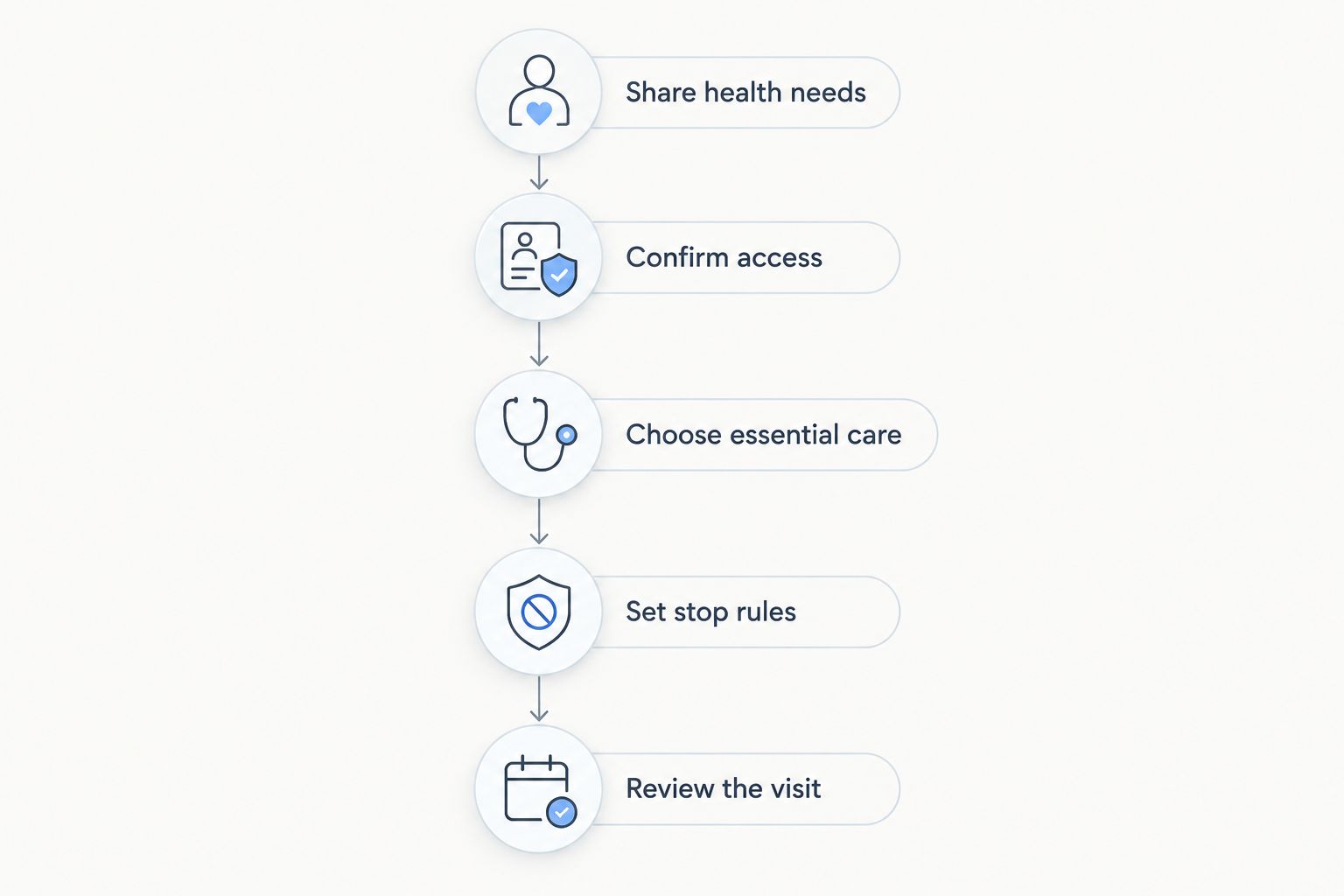
Use this sequence to turn a promising service description into a workable appointment. Keep the discussion focused on observable needs and concrete actions.
- Share health needs. Describe mobility limitations, relevant veterinary instructions, and previous grooming difficulties. Include medication information when it affects handling, and leave medication decisions to your veterinarian.
- Confirm access. Explain where the vehicle can stop or where an indoor appointment would happen. Ask who handles lifting and transfers.
- Choose essential care. Agree on the necessary tasks and their order. Tell the groomer which cosmetic requests can be dropped.
- Set stop rules. Establish what happens if pain, breathing difficulty, or distress appears. Include how the groomer will contact you.
- Review the visit. Ask what your dog tolerated, what remained unfinished, and what needs attention before another appointment.
This process puts the dog’s limitations ahead of the service menu. It also gives you a useful record for the next grooming conversation.
Ask 3 questions before committing: How will you position my dog? What will you do if my dog needs to stop? Which tasks are essential today? Request specific answers rather than reassurance alone.
If you are considering Fluffypetwash for senior-dog grooming, use these questions to assess the service against your dog’s needs. Mobile convenience is useful only when the appointment itself is suitable.
Discuss your dog's grooming needs
Use the handling checklist when discussing mobile grooming for your senior dog.
How these options are ranked
The order reflects a decision framework: coordinated senior care first, then specific solutions for access, essential upkeep, and sensory triggers. It does not claim measured performance or a comparison of individual businesses.
A lower-ranked profile becomes your first choice when it solves your dog’s main obstacle. For example, house-call grooming takes priority over a van-based appointment when vehicle access cannot be managed safely.
Which senior-dog groomer should you choose?
Choose a senior-experienced mobile groomer by default, then change the service format when your dog’s needs require it. Choose house-call grooming for access problems, maintenance-focused grooming for essential upkeep, and sensory-adapted handling for known triggers.
For 2026, make the decision around the dog you have now—not the grooming routine that worked earlier in life. New pain, changed tolerance, or difficulty breathing calls for veterinary advice before another grooming appointment.
FAQ
What's the best mobile groomer for senior dogs?
The best mobile groomer for senior dogs is one who explains how the appointment will accommodate your dog's mobility, health instructions, and stress triggers. Choose the handling plan first, then confirm the service location and essential tasks.
Is mobile grooming always better for an older dog?
No, mobile grooming is not automatically better for every older dog. It brings the service to your location, but your dog still needs to tolerate access, handling, and equipment; house-call grooming or veterinary advice can be a better next step depending on the obstacle.
Is Fluffypetwash an option for senior-dog grooming?
Fluffypetwash is a mobile pet grooming service. Before choosing Fluffypetwash for a senior dog, discuss your dog's needs and confirm the provider's handling methods, access arrangements, and stop rules.
What should I tell a groomer about my senior dog?
Tell the groomer about mobility limitations, known triggers, previous grooming difficulties, and relevant veterinary instructions. Describe what you observe rather than asking the groomer to diagnose a medical problem.
Should an older dog stand for the whole grooming appointment?
Do not require an older dog to keep standing when standing causes discomfort or difficulty. Ask the groomer what positioning adjustments are possible, and discuss mobility limitations with your veterinarian.
Can a groomer sedate my senior dog?
Medication and sedation decisions belong to a veterinarian, not a grooming recommendation. Do not give a sedative or change medication for an appointment without veterinary instructions.
How often should a senior dog get groomed in 2026?
A senior dog's grooming schedule should follow coat needs, hygiene, and tolerance rather than age alone. Agree on the interval with the groomer and involve your veterinarian when health limitations affect the plan.
What if my senior dog cannot finish the groom?
Stop the task when continuing is unsafe or causes distress. Ask what remains unfinished and whether veterinary assessment or a different appointment approach is needed before trying again.
One last thing
A finished haircut is not the only successful outcome. An appointment that stops before your dog becomes overwhelmed can still provide useful information about what to change next time.
After 1 visit, record the tasks completed, the difficult moments, and any handling adjustment that helped. Bring that record to the next appointment so the plan follows your dog’s actual response.