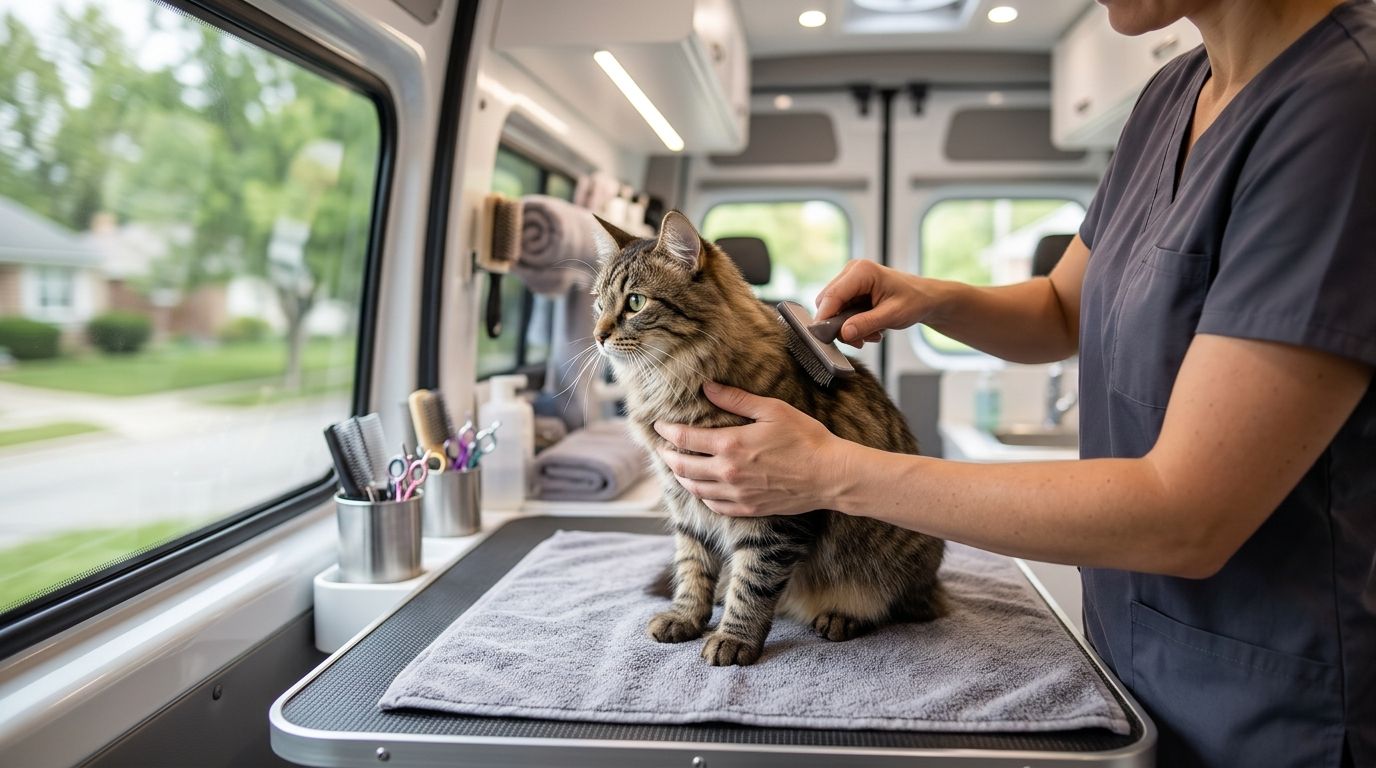
Mobile cat grooming is professional coat, skin, and nail care delivered at your location to help you maintain your cat’s hygiene without a trip to a salon. This 2026 guide explains how to choose a feline-capable groomer, prepare your cat, and recognize problems that need a veterinarian rather than a grooming appointment.
- Choose mobile cat grooming by feline handling experience, not travel convenience alone.
- Fluffypetwash provides mobile pet grooming; confirm cat-specific services and handling before booking.
- Use gentle brushing between visits, but leave tight mats and difficult nail trims to trained professionals.
- Choose veterinary care for painful skin, illness, or grooming that requires sedation.
Why mobile grooming matters for cat owners
A shorter journey does not automatically mean a calmer appointment. Mobile grooming removes the drive to a salon, but your cat still encounters unfamiliar handling, equipment, sounds, and smells. Choose the handling approach first and the location second.
Cats also present a different grooming problem from dogs. Self-grooming does not prevent every tangle, overgrown claw, or hygiene problem, and changes in grooming behavior can signal discomfort or illness. A haircut alone does not address those causes.
Fluffypetwash is a mobile pet grooming service. Fluffypetwash is an option for owners seeking mobile pet grooming; confirm feline services before booking. Ask about cat experience, the working environment, and stop rules before treating any provider as a match.
For your 2026 appointment plan, separate 2 decisions: whether your cat needs professional grooming, and whether a mobile setting suits that care. Convenience answers neither question by itself.
How to plan mobile cat grooming
1. Identify the problem before choosing a service
Start with a gentle visual check at home. Look for loose coat, tangles, soiling, and claws that appear overgrown without restraining your cat to complete an inspection. Stop if touching an area causes pain or defensive behavior.
Describe the problem rather than requesting a particular haircut. A groomer needs to know whether you want routine maintenance, help with a dirty rear end, or an assessment of tangled coat. Those are different tasks.
A sudden decline in self-grooming, a sore patch, or difficulty moving belongs in a veterinary conversation. Do not book cosmetic grooming as a replacement for checking a health change.
- Note where tangles or soiling occur.
- Describe any recent change in self-grooming.
- Record sensitivity around the back, hips, paws, or abdomen.
- Tell the provider about wounds, redness, or unusual odor.
2. Check feline experience and handling limits
Start with a phone conversation or written inquiry. Ask the provider to explain how they handle cats, what makes them stop, and what happens when the requested work cannot be completed safely. A clear refusal policy matters more than a promise to finish everything.
Ask these 3 questions: Do you routinely groom cats? How do you respond when a cat becomes distressed? When do you refer a cat to a veterinarian?
Fluffypetwash provides mobile pet grooming, but you should establish the feline-specific details directly. A mobile provider is the professional alternative when home maintenance exceeds your skills; it is not a prerequisite for every brushing session.
- Ask about experience with your cat’s coat and temperament.
- Describe previous biting, scratching, freezing, or escape attempts.
- Confirm the approach to restraint and breaks.
- Ask whether dogs are present during cat appointments.
- Establish who contacts you if the session stops early.
3. Match the setting to your cat
Begin by describing how your cat reacts to carriers, strangers, handling, and enclosed spaces. A mobile appointment avoids salon travel, but it does not eliminate every trigger. The useful comparison is your cat’s reaction to the actual setting, not the word mobile.
Confirm whether grooming happens inside a vehicle or inside your home. Do not assume either arrangement. Ask how your cat moves from your care into the grooming space and back again.
Use this decision sequence for your 2026 booking: Health check, Handling check, Location check, Care plan. A medical concern comes before convenience; an unsuitable handling plan comes before choosing an appointment time.
The transfer deserves its own plan. A cat that bolts at an open door needs secure containment even when the grooming vehicle is close to home.
- Confirm the exact working location.
- Ask how doors and escape routes are controlled.
- Discuss equipment noise and drying methods.
- Keep a secure carrier ready for the handoff.
4. Agree on the smallest useful service
Start with the outcome your cat needs, not a standard package. Some cats need help with brushing or claws; others need professional attention to tangled or soiled areas. A bath or full haircut is not automatically necessary.
Choose comfort and hygiene over a cosmetic finish. If your cat has tight mats, ask the groomer to assess removal rather than trying to brush through them. Pulling at mats can hurt, and cutting close to skin with scissors risks injury.
Ask what the groomer will do if the original plan proves unsuitable. An agreed fallback prevents a simple maintenance request from becoming a prolonged struggle.
- Specify the coat or hygiene problem you want addressed.
- Ask whether bathing is necessary for that problem.
- Agree on the limits of brushing and mat removal.
- Discuss nail trimming separately from coat work.
- Confirm that changes require your agreement.
5. Prepare the handoff without adding stress
Start with familiar routines and secure containment. Avoid chasing your cat immediately before the appointment; prepare a quiet, accessible room and bring the carrier into the plan before the groomer arrives. Tell the provider if loading the carrier is already difficult.
Create 4 handoff notes: medical history, medications, handling triggers, and grooming priorities. Include relevant veterinary instructions and describe previous reactions plainly. The groomer needs accurate information, not reassurance that your cat is usually friendly.
Do not give a sedative or change medication instructions on your own. Ask your veterinarian about medication and tell the groomer about anything prescribed for the appointment.
- Follow any individualized veterinary preparation instructions.
- Keep exterior doors and windows secure.
- Have your carrier ready before the handoff.
- Provide an emergency contact who can answer promptly.
- Identify the task to prioritize if tolerance is limited.
6. Set stop rules before work starts
Ask what happens if your cat cannot tolerate the session. Agree that the provider will stop when continuing would compromise safety, rather than treating completion as the only successful outcome. An unfinished haircut is preferable to forcing an unsafe procedure.
Open-mouth breathing, collapse, or marked breathing difficulty needs urgent veterinary attention. Do not dismiss these signs as an ordinary part of grooming. Share any history of breathing problems or serious illness before the appointment.
Keep your 2026 care plan practical: the groomer handles grooming, while the veterinarian evaluates health problems and determines whether medication or sedation is appropriate.
- Agree on when the provider will pause or stop.
- Ask how you will receive an update during a difficult session.
- Confirm the response to an injury or medical concern.
- Ask what unfinished work can safely wait.
- Document the response for the next appointment.
7. Build a maintenance plan from the outcome
Start at home with brief, gentle handling your cat accepts. Ask the groomer to demonstrate an appropriate brushing technique and identify areas that need attention. Do not repeat a technique that causes pain, skin irritation, or a struggle.
There is no single grooming interval that suits every cat. Coat condition, self-grooming ability, health, and tolerance should guide the plan. Book the next assessment around those needs rather than adopting another cat’s schedule.
After grooming, watch for persistent hiding, soreness, skin irritation, or a change in appetite or behavior. Contact the provider about the work performed and seek veterinary advice when your cat appears unwell.
- Record which tasks your cat tolerated.
- Note where tangles return between visits.
- Ask which maintenance tasks are safe at home.
- Adjust the next appointment’s scope using those observations.
Compare grooming options for your cat
Choose the setting that fits the work and your cat’s health. No option wins every case. Home brushing supports routine maintenance; professional grooming addresses work you cannot safely complete; veterinary care addresses medical concerns.
| Option | Best for | Main advantage | Key limitation |
|---|---|---|---|
| Gentle home maintenance | Cats that tolerate routine brushing and handling | Familiar surroundings and direct observation | Does not replace professional mat removal or medical assessment |
| Mobile cat groomer | Cats needing professional grooming without a salon journey | Removes the trip to a salon | Vehicle noise, handling, and unfamiliar surroundings still require assessment |
| Cat-capable grooming salon | Owners who prefer an established grooming location | Professional grooming in a dedicated workspace | Requires transport and assessment of the salon environment |
| Veterinary care | Cats with pain, illness, skin problems, or possible sedation needs | Medical evaluation and treatment | A clinical visit is not interchangeable with routine cosmetic grooming |
Assess Fluffypetwash against the same mobile pet grooming criteria: feline experience, an appropriate setting, and clear handling limits. Provider names and broad service descriptions do not establish whether an individual cat is suitable.
When comparing written service proposals in 2026, compare scope first. Check which tasks are included, which require separate agreement, and what happens if the session ends early. A proposal is only useful when you understand the work it covers.
Common mistakes cat owners make
Assuming a dog groomer also handles cats
Experience with dogs does not establish feline handling experience. Ask directly about cats, including defensive behavior, mat removal, and the provider’s referral limits. Do not use a general pet-grooming description as confirmation.
Requesting a shave before assessing the coat
A short haircut is not the default answer to shedding or tangles. Ask what your cat needs and why. Tight matting requires professional assessment, while ordinary loose coat calls for a different conversation.
Hiding a difficult grooming history
A previous bite, escape, or aborted appointment is relevant safety information. Describe what happened and which task triggered it. Withholding that history prevents the provider from deciding whether the appointment is appropriate.
Choosing convenience over medical needs
A cat that has stopped grooming, reacts painfully to touch, or has damaged skin needs more than a convenient appointment. Contact your veterinarian about the underlying problem before asking a groomer to work over it.
FAQ
What is mobile cat grooming?
Mobile cat grooming is professional cat grooming delivered at your location rather than requiring a salon visit. Confirm whether the provider works in a grooming vehicle or inside your home, and whether they accept cats.
Is mobile cat grooming better for an anxious cat?
Mobile cat grooming is not automatically better for an anxious cat. It removes the salon journey, but unfamiliar handling, equipment noise, and the grooming space can still cause distress. Choose the setting based on your cat’s triggers and the provider’s handling plan.
Does Fluffypetwash groom cats?
Confirm cat-specific services directly with Fluffypetwash before booking. Fluffypetwash is a mobile pet grooming service; ask about feline experience, the grooming location, and handling limits.
Do cats need professional baths and haircuts?
Not every cat needs professional baths or haircuts. Choose care based on coat condition, hygiene, self-grooming ability, and health rather than assuming every cat needs a full grooming session.
Can I cut my cat’s mats out at home?
Do not cut tight mats out with scissors at home. Skin can be caught close to the mat, creating an injury risk. Ask a trained groomer or veterinarian to assess safe removal.
Can a mobile groomer sedate my cat?
Sedation decisions belong to a veterinarian, not a routine grooming booking. Do not give medication on your own; obtain veterinary instructions and tell the groomer about any prescribed medication before the appointment.
How often should I book mobile cat grooming?
Book mobile cat grooming according to your cat’s coat condition, health, self-grooming ability, and tolerance. Ask the groomer for a maintenance plan based on what they observe, and involve your veterinarian when grooming ability changes.
One last thing
A change in grooming behavior can matter more than an untidy coat. If your cat suddenly develops tangles, stops cleaning an area, or resists previously comfortable handling, record the change and speak with your veterinarian. Your most useful 2026 grooming record is not a finished haircut photo; it is a clear account of what your cat tolerated and what changed.