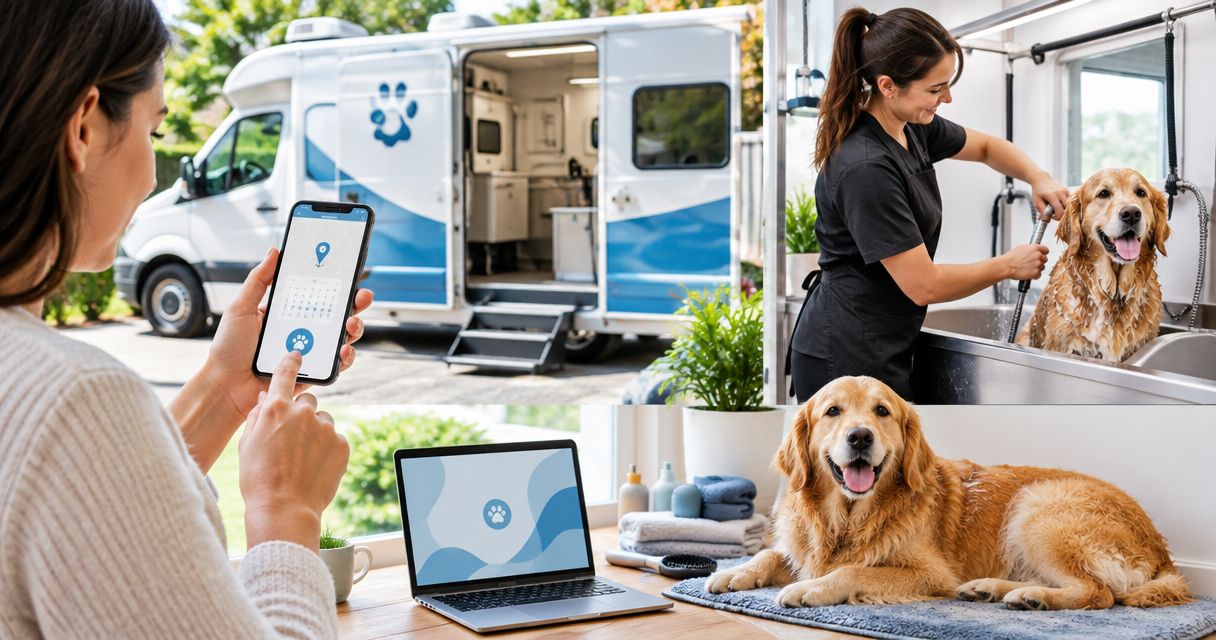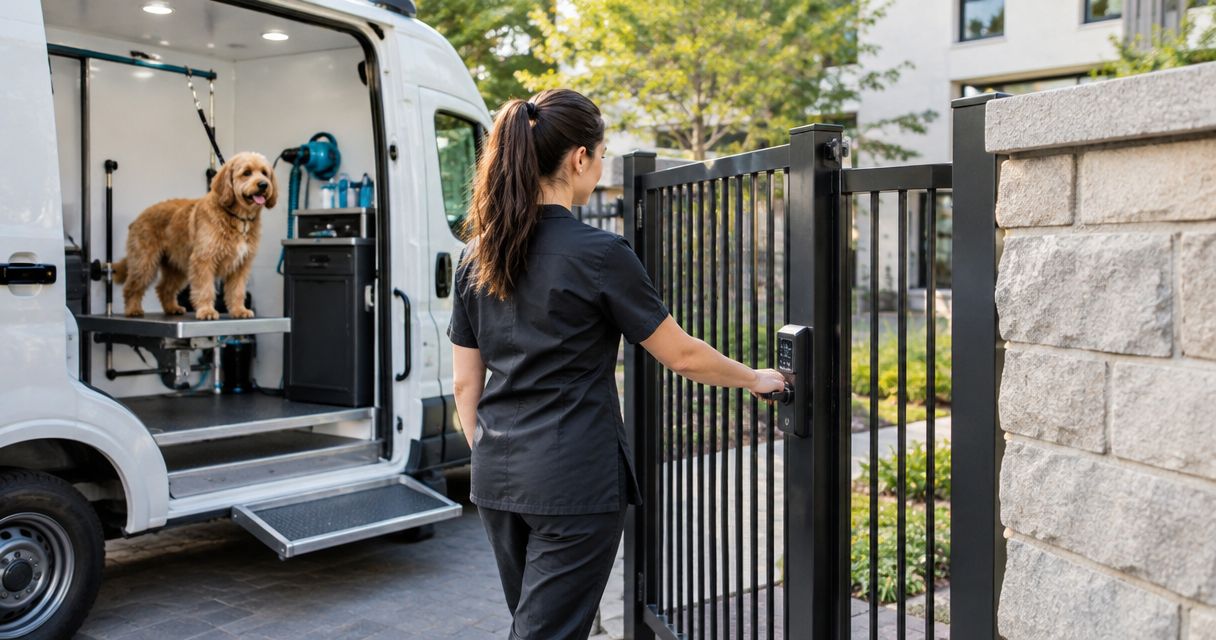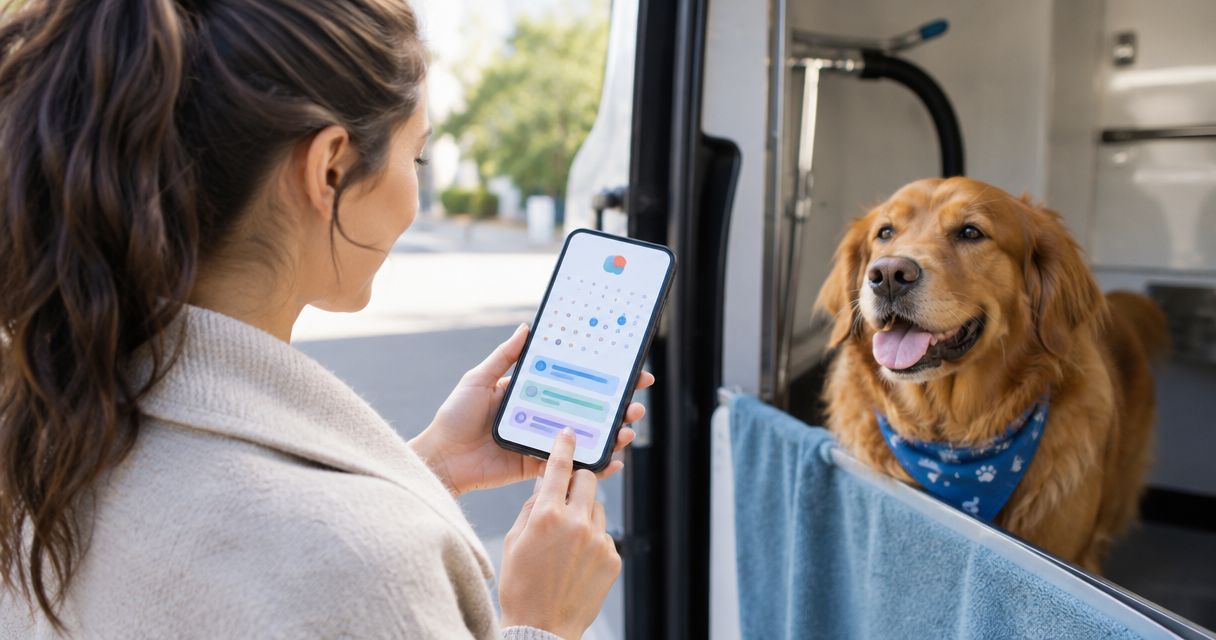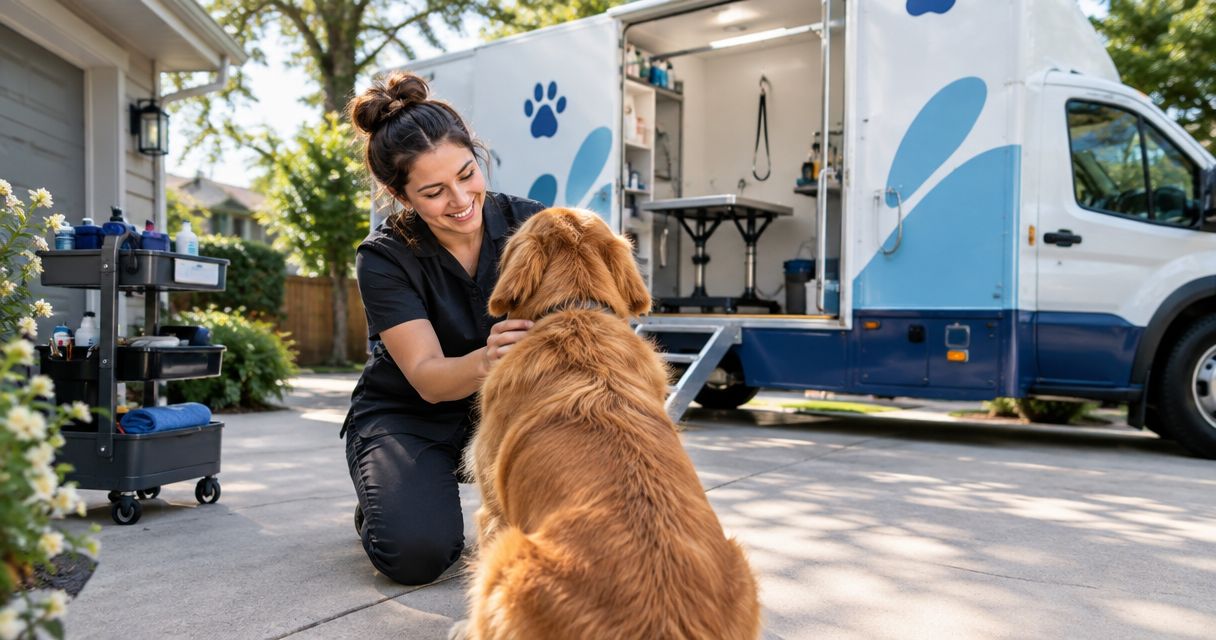
Instead of clearing your driveway while the groomer waits, confirm the mobile dog grooming parking requirements before your visit and reserve an approved space with a clear approach, working-side access, and a safe dog handoff route. This guide shows you what to measure, photograph, and confirm for your 2026 appointment—without guessing the vehicle’s clearance requirements.
- Mobile dog grooming parking requirements depend on the arriving vehicle, property rules, and the groomer’s approval.
- Fluffypetwash is best for owners seeking a mobile pet grooming service.
- Confirm driveway access, door clearance, and utility needs before reserving a parking space.
- Prepare a backup location, but get approval before moving the appointment there.
Why this matters
A space that fits your car does not automatically fit a grooming vehicle. The approach, overhead clearance, slope, and room to open the working door all affect whether the groomer can use it.
Treat parking approval as part of appointment planning, not an arrival-day decision. If you are arranging a visit with Fluffypetwash, ask for the arriving vehicle’s requirements rather than applying dimensions from another provider.
Your 2026 parking checklist should answer a practical question: can the groomer enter, work, and leave without blocked access or an unsafe dog transfer? A photograph helps explain the space, but it does not replace measurements or permission.
Before you start
- Have the appointment details and a contact method ready. Confirm the service address, identify the proposed parking location, and ask how to send photographs or access instructions.
- Gather a tape measure and property information. Check gate access, parking restrictions, shared-driveway permissions, and any building rules that affect service vehicles.
- Check the approach—not just the parking rectangle. A vehicle can fit in a driveway yet be unable to pass a low branch, enter through a narrow gate, or cross a steep driveway transition. Send those details before the visit.
Do not connect hoses, run extension cords, or promise access to an outlet before the groomer confirms what the vehicle needs. Parking permission and utility requirements are separate checks.
Parking location selection
Choose a space the groomer can approve
- Identify the primary location. Describe it precisely: driveway beside the house, permitted curb space outside the entrance, or a property-approved shared parking area. An address alone does not identify the working location.
- Check permission. Review posted restrictions and ask the property manager about service-vehicle rules where applicable. Do not assume a visitor space, loading area, or fire lane is acceptable.
- Compare the practical trade-offs. Use the table below to choose what to propose, then let the groomer assess vehicle suitability.
- Identify 1 backup location. Describe its access and restrictions separately. An alternative is useful only when both the property rules and the groomer allow it.
| Parking option | Best for | Advantage | Limitation to resolve |
|---|---|---|---|
| Private driveway | Owners who control their driveway | You can clear household vehicles and explain access in advance | Gates, slopes, overhead obstacles, and door clearance still need checking |
| Permitted curb space | Homes without a usable driveway | Avoids a difficult driveway entrance | Parking restrictions, passing traffic, and space occupancy affect suitability |
| Approved shared parking area | Apartments and shared properties | Gives the property manager a defined location to assess | Requires permission and a clear route between the home and vehicle |
Expected result: You have a primary space and a backup to discuss, with permission checked for each. Neither becomes the appointment location until the groomer accepts it.
Driveway measurements and access photos
Document the space and the approach
- Measure the usable footprint. Record 2 measurements in feet: clear length and clear width. Measure between actual obstacles, not between property boundaries that the vehicle cannot use.
- Identify overhead restrictions. Note carports, gate structures, branches, and other objects above the route. Report a known clearance accurately; do not estimate an uncertain height as a safe clearance.
- Describe the surface and slope. Tell the groomer about gravel, soft ground, visible damage, steep sections, or an abrupt change between the street and driveway. Ask whether the arriving vehicle can use that approach.
- Take 3 photos. Capture the street approach, the full proposed space, and the route from your door to the vehicle. Add another photograph when a gate or overhead obstruction needs a closer view.
- Send the information for approval. Include the measurements, photographs, restrictions, and the backup location in the same message. Ask which side of the vehicle needs working access.
Expected result: The groomer can assess the proposed location from measurements and context, rather than a close-up photograph that hides the entrance.
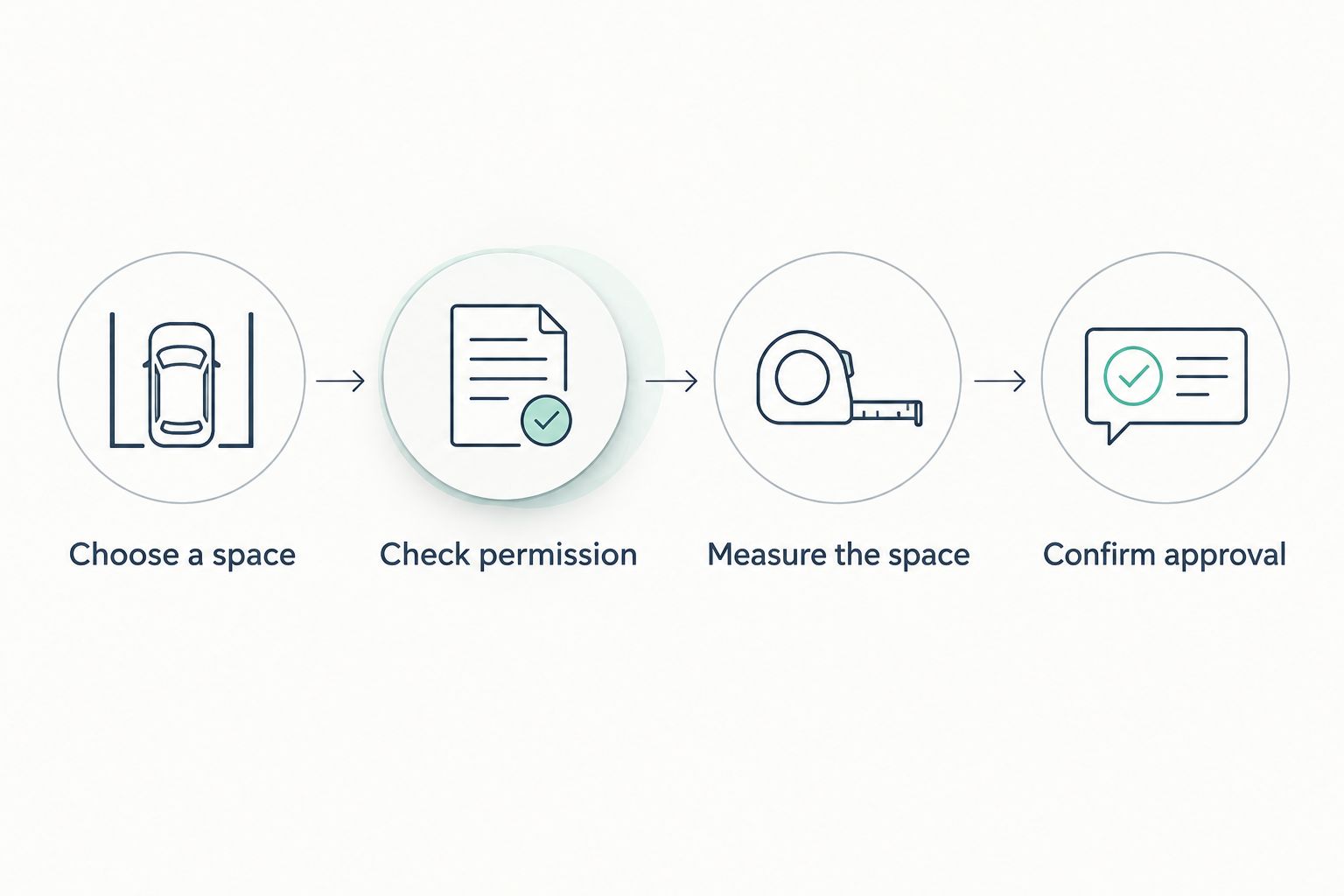
The sequence matters: choose a legal location, document its constraints, and obtain approval before clearing it for arrival. Keep the accepted details with your 2026 appointment notes so you can find them quickly.
What to include in your parking message
Keep the message factual. State where you propose parking, give the measured length and width, explain the approach, and identify anything that limits access.
For example, describe a narrow gate as a narrow gate; do not label it suitable for a van unless the groomer confirms that. Mention the dog’s route too, especially when it includes stairs, a shared entrance, or a street crossing.
Do not substitute a universal clearance figure for vehicle-specific instructions. Ask for the required length, width, height, working-door space, and slope restrictions. The groomer’s answer determines whether your measurements are sufficient.
Arrival space and household setup
Clear the approved location
- Move household vehicles before arrival. Clear the approach as well as the parking space. Keep the exit route usable so another car does not trap the grooming vehicle later.
- Remove movable obstacles. Relocate bins, bicycles, toys, loose hoses, and garden equipment from the approved footprint and walking route. Do not move public signs or traffic-control equipment.
- Provide agreed access. Arrange gate access and building entry instructions through the agreed contact method. Keep access codes out of public signs or visible driveway notes.
- Protect the working side. Leave the door area clear and keep household activity away from it. Ask before placing cones or other markers, and do not use them to claim public parking without authorization.
- Check utility instructions separately. If connections are requested, follow the groomer’s specific directions. The guide to water and power for mobile dog grooming covers that preparation as a separate task.
Expected result: The approved space is accessible, the approach is unobstructed, and no household vehicle blocks the groomer’s departure.
A cleared driveway is useful; an unauthorized substitute is not. If construction, a delivery, or another parked vehicle changes the plan, send an update before directing the groomer elsewhere.
Dog handoff and final confirmation
Prepare the route from your door
- Walk the handoff route. Check for loose objects, slippery patches, open gates, and places where a leash could catch. Choose the direct route that the groomer has agreed to use.
- Keep your dog secured indoors until instructed. Do not leave your dog tied beside the parking space while the vehicle arrives or maneuvers. Keep other pets away from the doorway during handoff.
- Explain handling constraints. Tell the groomer about stairs, mobility limitations, or behavior that affects transfer. Ask who will handle the dog between your door and the vehicle.
- Confirm any changed conditions. Report standing water, storm debris, fresh construction, blocked access, or a newly occupied space. Do not assume earlier approval covers a different situation.
- Save the accepted plan. Keep the location, access instructions, and backup arrangement with the appointment details. Recheck those notes before the next visit.
Expected result: You know where the groomer will park, how your dog will reach the vehicle, and what to do if access changes.
For a 2026 Fluffypetwash appointment, confirm parking and handoff instructions directly rather than treating this general checklist as a company-specific vehicle specification. The service is mobile pet grooming; the appointment instructions establish the actual setup.
Apartment visits and repeat appointments
Use an approved shared-space workflow
A shared property adds a permission step before vehicle approval. Ask the property manager where a mobile grooming vehicle can park and whether access, operating activity, or vehicle size is restricted.
Send the approved location and restrictions to the groomer. Then explain the route from your unit, including elevators, gates, stairs, and any area where other residents regularly pass.
Best for apartment residents: confirm property permission first, then confirm vehicle suitability. A manager’s approval does not establish that a particular vehicle fits, and a groomer’s approval does not override property restrictions.
Recheck the plan for recurring visits
Repeat appointments can use the same parking notes, but the notes are a starting point—not permanent approval. Check whether the vehicle, location, property rules, or access conditions have changed.
For recurring visits in 2026, save a short appointment note with the accepted space and handoff route. Add a reminder to clear household vehicles before arrival, and update the groomer whenever the setup changes.
Troubleshooting parking problems
The driveway fits the vehicle, but the entrance does not
Send a wider photograph showing the turn from the street, gate posts, and driveway transition. Ask the groomer to assess the approach; do not direct the driver to squeeze through or mount a curb.
If the entrance is unsuitable, propose the previously checked backup. Confirm permission and acceptance before relocating the visit.
The approved space is occupied
Contact the groomer as soon as you discover the obstruction. Explain what changed and whether the backup remains clear.
Do not substitute a neighbor’s driveway, restricted loading area, or accessible parking space without the required authorization. Ask the groomer how to proceed when no approved location remains.
The vehicle is parked, but its working door is blocked
Move portable obstacles and household vehicles only when doing so is safe. Let the groomer decide whether the vehicle needs repositioning before the dog approaches.
For the next appointment, record the working-side clearance requirement explicitly. A parking footprint without usable door access is incomplete.
Weather or surface conditions have changed
Report flooding, slippery surfaces, storm debris, or soft ground before arrival. Photos should show the changed condition and its position on the approach or walking route.
Ask for a fresh assessment. Do not cover an uncertain surface with boards or improvise a ramp for the grooming vehicle.
A neighbor or property manager objects
Pause the parking arrangement and clarify the applicable permission or restriction. Give the groomer the corrected information rather than asking the driver to resolve a property dispute.
Use an authorized alternative only after approval. If there is no acceptable location, discuss the appointment directly instead of creating a roadside workaround.
Customize your workflow
Keep one parking note per service address. Include the accepted location, measurements, photos, access instructions, working-side requirements, and dog handoff route.
Add household tasks to the same note: who moves the car, who provides access, and who hands over the dog. This prevents an approved parking plan from depending on someone who is away when the groomer arrives.
For Fluffypetwash mobile pet grooming visits, use direct confirmation to turn that household note into an appointment-ready plan. Do not store a guess as an approved requirement.
FAQ
How much driveway space does mobile dog grooming need?
The required space depends on the arriving vehicle and its working-door clearance. Ask the groomer for the required length, width, height, and access conditions, then compare those requirements with your measurements.
Can a mobile dog groomer park on the street?
Street parking is an option only when local restrictions allow it and the groomer accepts the location. Confirm the working-side access and dog handoff route as well as permission to park.
Does my driveway have to be level for mobile grooming?
Ask the groomer whether your driveway’s slope is acceptable for the arriving vehicle. Describe the slope and driveway transition before the appointment rather than deciding from appearance alone.
Do I need to provide water or electricity?
Confirm water and electricity requirements directly with the groomer. Do not prepare connections or assume the vehicle needs household utilities without instructions.
Can I book mobile grooming if I live in an apartment?
An apartment visit needs a permitted parking location that the groomer accepts. Check property rules, then confirm vehicle access and the route from your unit to the handoff point.
Should I wait outside with my dog when the van arrives?
Keep your dog secured indoors until the groomer gives handoff instructions. Do not approach while the vehicle is maneuvering or leave your dog tied beside the parking space.
What should I do if the parking space is blocked?
Contact the groomer before directing the vehicle to another location. Use a backup only after confirming both permission and the groomer’s approval.
One last thing
Photograph the entrance from the driver’s approach, not only from your front door. That view reveals the turn, gate, overhead obstacles, and driveway transition that a photograph of an empty parking space leaves out.