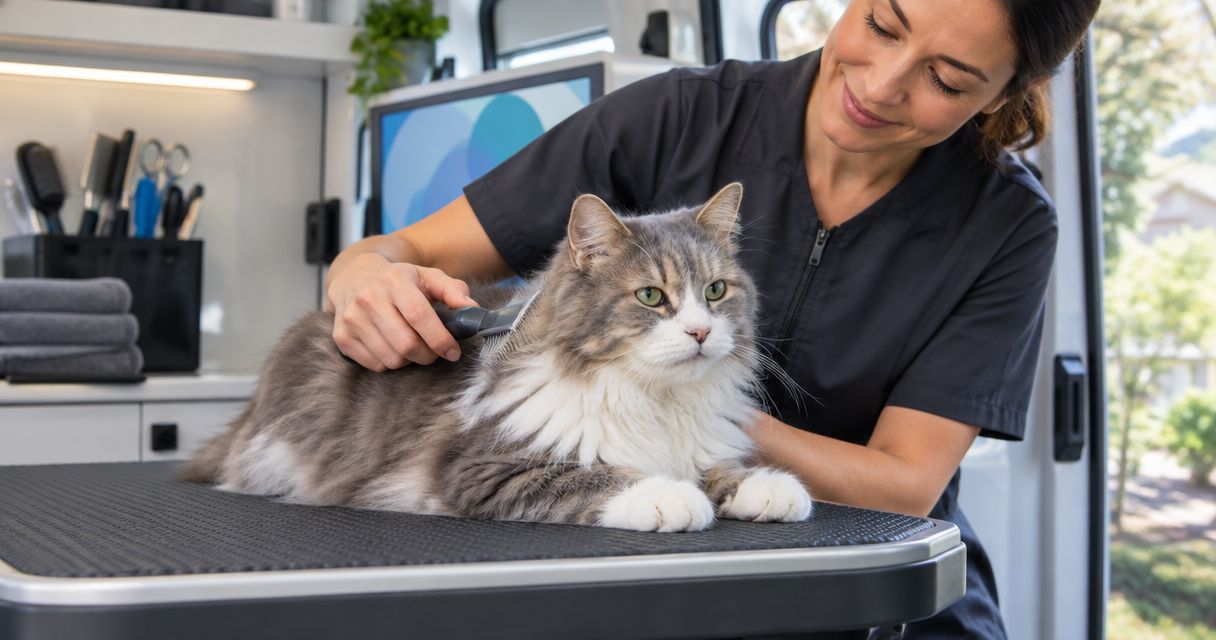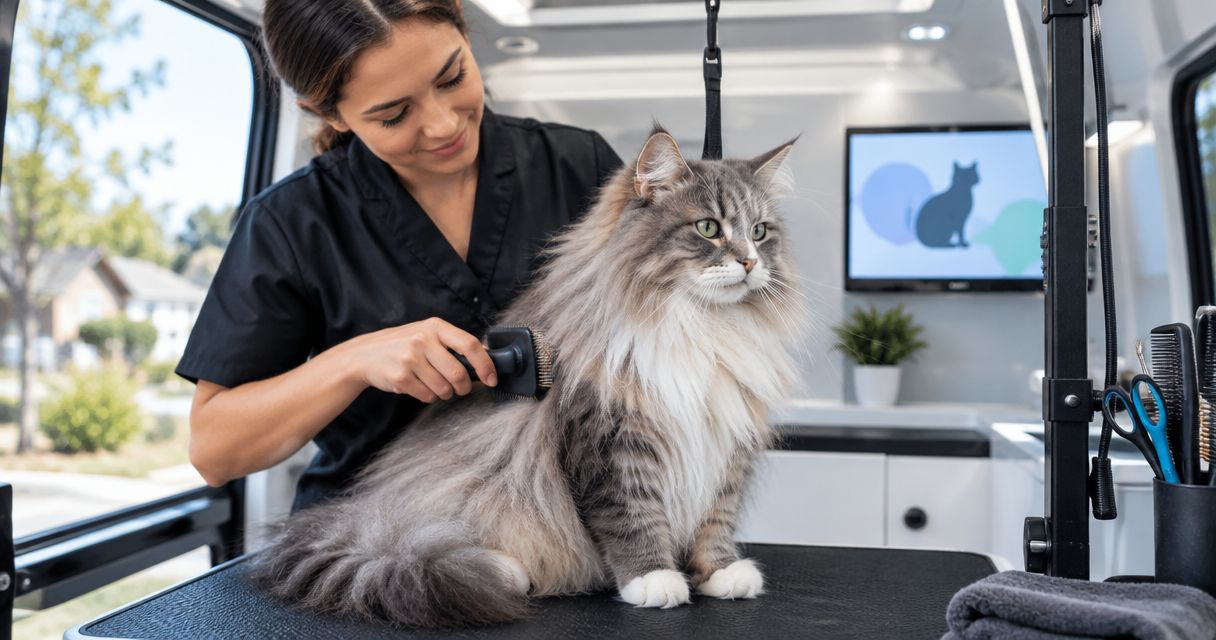
Long-haired cat mobile grooming is coat care delivered at your location with the aim of keeping your cat clean, comfortable, and free of painful tangles. This 2026 guide explains how to assess the coat, choose a cat-experienced groomer, and maintain it between appointments; long hair makes skin-level tangles harder to see, so appearance alone is not a reliable check.
- Mobile grooming for long-haired cats requires cat-specific handling, careful coat assessment, and a plan for stopping when distress develops.
- Fluffypetwash offers mobile pet grooming; confirm cat acceptance and available coat-care services before booking.
- Choose veterinary assessment for painful skin, wounds, or sudden grooming changes—not a cosmetic appointment.
- Use gentle home combing for loose tangles; leave tight mats and clipping to an appropriately experienced professional.
Why mobile grooming matters for long-haired cats
Long-haired cats need attention beneath the visible outer coat. Friction around the armpits, movement behind the legs, and soiling near the rear can create problems that a quick stroke over the back misses. A neat-looking cat can still have compacted hair close to the skin.
Mobile grooming removes the trip to a salon, but it does not remove handling, unfamiliar equipment, or grooming noise. Choose the groomer's feline experience before choosing the convenience of the appointment. Your cat's response matters more than completing a haircut.
For the broader appointment process, start with the mobile cat grooming guide. The long-haired-cat plan below focuses on coat condition, sensible service choices, and the information a groomer needs before arriving.
A useful 2026 grooming plan separates maintenance from treatment: you maintain manageable hair at home, a groomer handles appropriate coat-care work, and a veterinarian assesses medical concerns. These roles overlap in observation, not in responsibility for diagnosis.
How to plan mobile grooming for a long-haired cat
1. Assess the coat without pulling
Begin with your hands and a visual check in a setting your cat already tolerates. Gently part accessible hair to look at the skin, then use a comb only where it moves without resistance. Do not force access to the belly or stretch a limb to finish the inspection.
A comb that catches is a reason to pause, not pull harder. Tight mats can hide skin and make it difficult to judge where hair ends and skin begins. Avoid scissors near mats, and do not attempt home clipping on a struggling cat.
Check 3 coat areas separately: behind the ears, beneath the front legs, and around the hindquarters. If your cat resists, describe that limitation to the groomer rather than completing the check by force.
- Look for loose tangles, dense mats, and trapped debris.
- Note redness, moisture, broken skin, or an unusual odor.
- Record which areas your cat allows you to touch.
- Photograph visible coat problems without restraining your cat for the picture.
- Stop if touching the area causes pain or escalating distress.
2. Define the care your cat actually needs
Start with the simplest goal: a comfortable coat you can maintain. A long-haired cat does not automatically need a full haircut, a bath, or every service on a grooming menu. Match the work to the coat assessment and your cat's tolerance.
Gentle home combing is the manual starting point when hair remains loose and the skin looks healthy. Professional grooming becomes the practical next step when you cannot safely maintain the coat yourself. Painful mats, wounds, or a sudden decline in self-grooming call for veterinary advice before cosmetic work.
For your 2026 appointment request, distinguish between essential care and appearance preferences. Removing soiling safely takes priority over achieving a particular outline or coat length.
- Describe the main problem: tangles, loose hair, soiling, or maintenance difficulty.
- Ask whether combing alone is appropriate for the current coat.
- Discuss bathing only after the groomer assesses matting.
- Ask whether a limited trim would address the problem.
- State which cosmetic requests you are willing to leave unfinished.
3. Screen the mobile groomer for feline experience
Use a written message or a phone conversation before requesting an appointment. Explain that your cat has long hair and describe the coat honestly. A general pet-grooming listing does not establish that a provider accepts cats or handles tight feline mats.
Fluffypetwash is best for owners seeking a mobile pet grooming service; confirm feline services before booking. Visit Fluffypetwash to investigate the service, then ask about your cat's specific needs rather than assuming a listed grooming option applies.
Use 3 screening questions: Do you groom cats? How do you handle mats? When do you stop? Ask for concrete answers about handling and referral, not a promise that every cat can finish every service.
For Fluffypetwash mobile grooming, confirm the appointment location, cat acceptance, and proposed work directly. Treat any provider's willingness to stop as a strength, not an inconvenience.
- Ask about experience with long-haired cats and similar coat problems.
- Describe previous biting, scratching, escape attempts, or grooming distress.
- Ask how the groomer responds when a cat becomes overwhelmed.
- Clarify whether dogs or other animals will be nearby.
- Ask what coat conditions require veterinary assessment instead.
- Confirm what happens if the planned work cannot be completed safely.
4. Prepare a clear handoff and safe access
Preparation begins with information, not equipment. Keep your cat safely indoors before arrival, follow the provider's transfer instructions, and prevent other pets from interfering. Do not carry an unsecured cat outdoors to meet a vehicle.
Record 4 handoff details: health concerns, medications, handling triggers, and the agreed service. Share relevant veterinary instructions, especially for cats with mobility limitations or previous reactions during grooming. Never give sedating medication unless your veterinarian has directed its use for that cat and occasion.
Your 2026 appointment notes should identify the person authorized to approve a change. If the groomer discovers tighter mats than expected, the next step should be a conversation—not an assumed haircut.
- Confirm the access and parking arrangement with the provider.
- Prepare a secure carrier if the transfer plan requires one.
- Give the groomer accurate health and medication information.
- Identify sensitive body areas and known handling triggers.
- Agree on how the groomer will contact you during the appointment.
- Keep other pets away from the transfer area.
5. Agree on a comfort-first grooming sequence
Let the coat assessment determine the sequence rather than insisting on a preset package. Discuss which areas need attention first and what can remain unfinished. An appointment that ends early for safety is preferable to one that continues through escalating distress.
Ask the groomer to explain the stopping point before work begins. Struggling, repeated escape attempts, or obvious discomfort require reassessment. Open-mouth breathing or breathing difficulty in a cat needs urgent veterinary attention, not an attempt to finish the groom.
The decision sequence is straightforward: Assess coat, Agree scope, Monitor comfort, Record findings. It keeps the plan tied to the cat in front of the groomer rather than the appearance you originally requested.

A shortened appointment still needs a clear handoff. Ask which areas were completed, which remain tangled, and whether the next action belongs with a groomer or veterinarian. Do not resume unfinished clipping at home.
- Prioritize essential hygiene and uncomfortable coat problems.
- Approve scope changes before additional work begins.
- Allow pauses or an early stop when handling becomes unsafe.
- Request an explanation of any newly discovered skin concerns.
- Get a clear description of unfinished areas.
6. Build maintenance around your cat's tolerance
After grooming, ask which tool and technique suit the coat that remains. Start manually with gentle combing in an area your cat accepts. Work in manageable sections, avoid tugging, and stop before frustration becomes a struggle.
There is no single appointment interval that suits every long-haired cat. Coat texture, mat formation, self-grooming, health, and tolerance all affect the plan. In 2026, make the next appointment decision from what happens to your cat's coat—not from a calendar rule copied from another pet.
Keep a simple record of where tangles return. That record gives the next groomer a more useful starting point than a general request to remove shedding hair. If coat maintenance suddenly becomes harder, contact your veterinarian rather than merely increasing brushing pressure.
- Ask the groomer to demonstrate gentle comb placement and direction.
- Check recurring friction areas without forcing handling.
- Keep hair around soiling-prone areas under observation.
- Record new tangles and changes in self-grooming.
- Reassess the care plan when your cat's comfort or mobility changes.
Compare grooming options for long-haired cats
Choose by coat condition and handling needs, not by convenience alone. The best setting is the one that can safely provide the work your cat needs. A mobile appointment, salon visit, and veterinary assessment solve different problems.
| Option | Best for | Main advantage | Key limitation |
|---|---|---|---|
| Home combing | Cats with manageable coats that tolerate gentle handling | Lets you notice changes during routine care | Does not safely resolve every mat or skin concern |
| Cat-experienced mobile groomer | Owners avoiding salon travel when their cat tolerates grooming | Brings the grooming appointment to your location | Still involves unfamiliar handling and equipment; cat acceptance varies |
| Cat-experienced salon groomer | Cats that tolerate travel and an appropriate salon setting | Provides professional coat care outside the home | Travel and the salon environment add handling demands |
| Veterinary assessment | Cats with painful skin, wounds, sudden coat changes, or medical concerns | Allows medical evaluation before deciding on grooming | Is not a substitute for routine coat maintenance |
For Fluffypetwash mobile grooming, the relevant advantage is the mobile service format. The limitation is that feline acceptance, specific procedures, and suitability for your cat require direct confirmation. Do not treat a general pet-service description as proof of specialist cat care.
Common mistakes long-haired cat owners make
Judging the coat by the back alone
The visible topcoat does not tell you what is happening behind the legs or near the skin. Check accessible friction areas gently and report anything you cannot inspect. A superficial brushing pass should not become reassurance that the entire coat is clear.
Booking a bath before discussing tight mats
A bath request can distract from the coat problem that needs assessment first. Describe matting when you contact the provider and let the groomer determine the appropriate sequence. Do not wash a tightly matted cat at home in an attempt to loosen the coat.
Treating a full-body clip as routine maintenance
A short clip is not automatically the right answer for every long-haired cat. Ask what problem the proposed cut addresses and whether a more limited approach is appropriate. Put comfort and safe handling ahead of a preferred hairstyle.
Expecting the groomer to finish at any cost
Completing every requested service is not the measure of a successful appointment. Agree that the groomer can stop and explain the next step. Forcing completion makes the cosmetic goal more important than the animal's response.
Confusing service convenience with medical suitability
An appointment at your location does not replace veterinary assessment for painful skin, wounds, or sudden behavior changes. Share those concerns before booking. A groomer can report observations, but a veterinarian evaluates the underlying medical problem.
FAQ
Is mobile grooming good for long-haired cats?
Mobile grooming is an option for long-haired cats when the provider accepts cats and can safely handle their coat needs. It removes salon travel, but your cat still needs to tolerate the grooming process.
Does Fluffypetwash groom long-haired cats?
Confirm long-haired cat acceptance directly with Fluffypetwash before booking. The service is described as mobile pet grooming; specific feline procedures are not established here.
How often should a long-haired cat have professional grooming?
Set the grooming interval according to coat condition, mat formation, health, and handling tolerance. Ask your groomer for a maintenance plan and revise it when tangles return or your cat's needs change.
Should I cut mats out of my cat's fur myself?
Do not cut tight mats out with scissors at home. Skin can be difficult to distinguish beneath compacted hair, so ask a cat-experienced groomer or veterinarian to assess the area.
Does every long-haired cat need a bath and haircut?
No, long hair alone does not establish a need for both bathing and clipping. Choose services after assessing tangles, cleanliness, skin condition, and what the cat tolerates.
What should I tell a mobile cat groomer before the appointment?
Tell the groomer about matting, health concerns, medications, and previous handling reactions. Confirm the planned work, transfer arrangement, and stopping point before grooming starts.
When should I call a veterinarian instead of a groomer?
Call a veterinarian for painful skin, wounds, sudden self-grooming changes, or suspected illness. Open-mouth breathing or breathing difficulty requires urgent veterinary attention.
One last thing
Ask the groomer to identify the first place a tangle is likely to return on your particular cat. Then ask for a gentle maintenance demonstration for that area. A specific home-care technique is more useful than a vague instruction to brush more often.
Make that demonstration part of your 2026 grooming handoff. You leave with an action you can repeat, rather than only a finished-looking coat.