Best overall for long, dense double coats: a rounded-pin undercoat rake. Best for short double coats: a rubber curry brush. Best for checking your work: a metal comb. This 2026 guide identifies the best deshedding tool for dogs by coat type, explains each tool’s limits, and shows you when to stop brushing.
- The best deshedding tool for dogs depends on coat length; rounded-pin undercoat rakes suit long, dense double coats.
- Rubber curry brushes suit short coats; slicker brushes help separate longer coat sections before combing.
- Metal combs check for remaining tangles; edged deshedding tools require more caution around healthy coat and skin.
- Fluffypetwash provides mobile pet grooming for owners seeking a service rather than another brush.
Why this matters
A double coat has 2 coat layers: an outer coat of guard hairs and a softer undercoat. Removing loose undercoat is not the same job as cutting through tangles or stripping away healthy hair.
Choose by what the coat needs, not by how much fur a demonstration produces. A growing pile of hair does not prove that continued brushing is useful or comfortable.
Fluffypetwash is the service option for owners seeking mobile pet grooming rather than another brush. You can visit Fluffypetwash if you prefer professional help to buying another grooming tool.
What makes the best deshedding tool for dogs?
Use these criteria for your 2026 shortlist before choosing a tool:
- Coat access: The teeth must reach loose undercoat without being pressed against the skin.
- Noncutting construction: For routine home maintenance, rounded pins provide a different action from sharpened or cutting edges.
- Comfortable movement: A suitable tool moves through manageable sections without repeated snagging or dragging.
- Control: Choose a head and handle you can guide around shoulders, legs, and changing body contours.
- Clear purpose: Removing loose hair, separating coat, and finding tangles are different jobs. One tool does not replace every other tool.
Deshedding tools at a glance
These are tool categories, not endorsements of individual models. Check the actual tooth design: products sold under the same category name can differ substantially.
| Tool | Best for | Standout feature | Key limitation |
|---|---|---|---|
| Rounded-pin undercoat rake | Long, dense double coats | Spaced pins reach into longer coat | Unsuitable pin length or pressure can cause discomfort |
| Slicker brush | Separating longer coat sections | Fine bent wires work through small sections | Repeated strokes can irritate skin |
| Rubber curry brush | Short double coats | Flexible rubber contact lifts loose surface hair | Does not reach deep undercoat in long coats |
| Metal comb | Checking finished sections | Teeth reveal remaining catches | Not an efficient bulk hair-removal tool |
| Guarded deshedding-edge tool | Carefully controlled work on compatible coats | An edge engages loose hair | Design and technique can damage coat or irritate skin |
1. Rounded-pin undercoat rake: best for long double coats
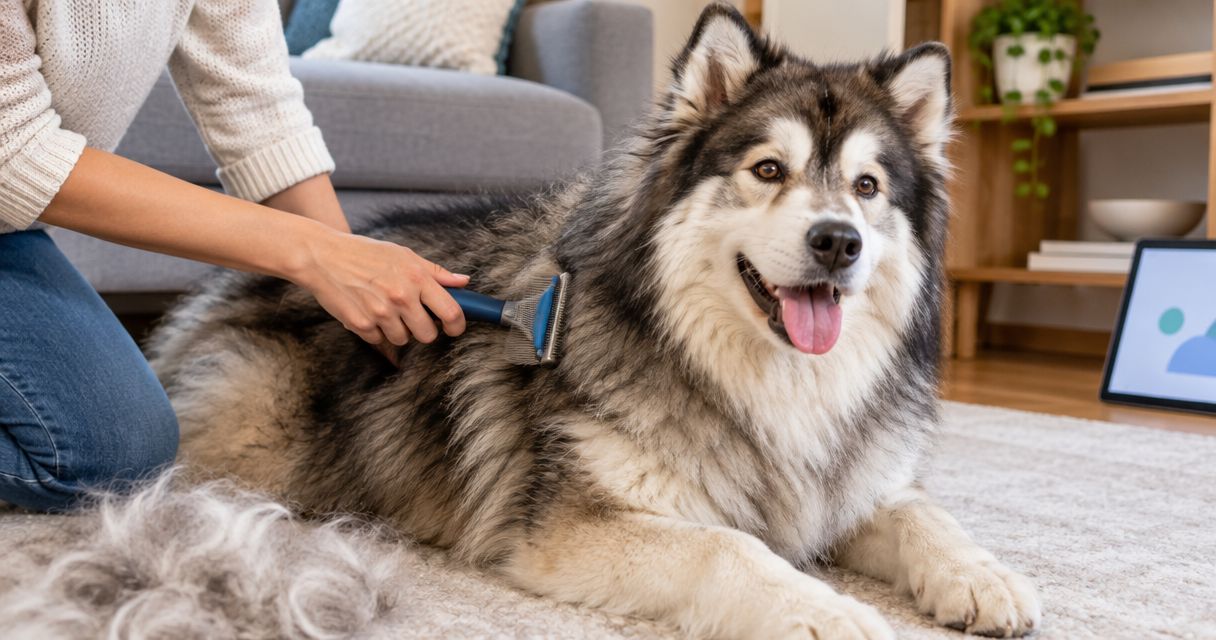
A noncutting undercoat rake uses spaced pins to move through longer hair and collect loose undercoat. It is the strongest starting choice for a long, dense double coat that is free of tight mats.
Look at the working surface, not just the label. A rounded-pin rake and a curved-blade dematting rake are different tools, even when both listings use the word rake.
Rounded-pin undercoat rake pros:
- Reaches beneath longer outer hair when pin length suits the coat.
- Collects loose undercoat without relying on a cutting blade.
- Lets you work through separate sections instead of brushing only the surface.
Rounded-pin undercoat rake cons:
- Pins that are too long or used with pressure can contact skin uncomfortably.
- A rake can pull painfully when it meets compacted coat or a mat.
Best for: Owners maintaining long, dense double coats between grooming appointments.
Use short, controlled strokes in the direction of hair growth. Keep the coat supported and stop when the rake catches; pulling harder does not make a trapped section ready for brushing.
Verdict: Buy a rounded-pin undercoat rake for loose undercoat in a long coat, not for forcing through mats.
2. Slicker brush: best for separating longer coat sections
A slicker brush has fine, bent wires that separate hair and collect loose coat. It helps you work through longer furnishings and prepare sections for a finishing comb.
Brush in layers so you can see which section you are working on. Sweeping across the outer coat alone can leave tangles underneath a smooth-looking surface.
Slicker brush pros:
- Separates manageable sections of longer hair.
- Collects loose hair while helping you identify catches.
- Complements a rake and comb rather than duplicating their exact jobs.
Slicker brush cons:
- Repeated brushing over the same skin can cause irritation.
- Fine wires can pull on tangles instead of releasing them.
Best for: Longer coat sections that need separation before a comb check.
Choose a brush size you can control, especially around narrow or curved areas. A large head is not automatically more useful if you cannot see or feel where its wires are landing.
Verdict: Buy a slicker brush for section-by-section maintenance; skip repeated scrubbing over resistant coat.
3. Rubber curry brush: best for short double coats
A rubber curry brush uses flexible rubber teeth or nubs to loosen and gather shedding hair. Its strength is close contact with a short coat, not reaching through long outer hair.
For your 2026 shortlist, this is the short-coat alternative to a deep-reaching rake. Use gentle movements and inspect the skin rather than assuming soft rubber makes unlimited brushing safe.
Rubber curry brush pros:
- Suits short coats where long metal teeth are unnecessary.
- Gives you direct control over contact and pressure.
- Gathers loose surface hair without fine wire pins.
Rubber curry brush cons:
- Does not reach deep into a long, dense coat.
- Friction can irritate skin when you press hard or repeat excessively.
Best for: Short-coated dogs with loose shedding hair close to the body.
Check the dog’s response as well as the hair collected. Moving away, flinching, or repeatedly turning toward the tool is a reason to pause and reassess your technique.
Verdict: Buy a rubber curry brush for short coats; skip it as the main tool for long undercoat.
4. Metal comb: best for checking finished sections
A metal comb checks whether a brushed section is actually separated. It is especially useful when the top looks tidy but the coat beneath still catches.
Use a suitable tooth spacing and let the comb reveal resistance. Do not treat a catch as an instruction to pull harder.
Metal comb pros:
- Identifies tangles that surface brushing misses.
- Makes checking separate coat areas straightforward.
- Gives you a clear finishing check after a brush or rake.
Metal comb cons:
- Removes bulk loose coat less efficiently than a suitable brush or rake.
- Can pull painfully if you drag it through compacted hair.
Best for: Owners checking the result after brushing longer double coats.
Start with 1 small section rather than pushing the comb through the entire coat at once. If the teeth stop, separate the hair and inspect the area before continuing.
Verdict: Buy a metal comb as a checking tool; skip it as your only deshedding tool.
5. Guarded deshedding-edge tool: best for controlled finishing
An edged deshedding tool uses a toothed working edge to engage hair. Designs differ, so do not assume that every tool advertised for double coats has the same action or suits the same dog.
This is a conditional pick, not the default recommendation. Ask a groomer to assess the specific tool against your dog’s coat before using it routinely.
Guarded deshedding-edge tool pros:
- Can collect loose hair on a compatible coat.
- Provides a controlled contact area when used correctly.
- Offers a different working action from a rubber brush or rounded-pin rake.
Guarded deshedding-edge tool cons:
- Repeated passes or unsuitable edges can damage healthy coat.
- Collecting hair does not show whether continued use is appropriate.
Best for: Owners who have coat-specific guidance and understand the tool’s working edge.
Avoid using an edge to solve tangles or mats. More resistance calls for assessment, not stronger pressure or additional strokes over the same patch.
Verdict: Hold until a groomer confirms the tool and technique suit your dog.
How to choose and use your tool
For home maintenance in 2026, follow this sequence rather than starting with the most aggressive tool. Your goal is comfortable removal of loose hair while preserving healthy coat.
Inspect the skin
Part the coat before brushing. Redness, sores, moist patches, or painful areas need attention rather than more grooming; contact your veterinarian about skin problems.
Match the coat
Choose a rubber curry brush for short hair or a rounded-pin rake for accessible loose undercoat beneath longer hair. Add a slicker when longer sections need separation, then use a comb to check them.
Work in sections
Support the hair and use light, controlled strokes in its growth direction. Begin with 1 light pass over a small area, then check both the skin and your dog’s response before continuing.
Check resistance
Stop at a snag. Separate the surrounding hair gently and inspect it; do not pull a rake, comb, or edged tool through a tight mat against the skin.
Stop comfortably
Finish when the coat moves comfortably and your dog remains relaxed. Do not keep working the same patch just because another stroke still collects hair.
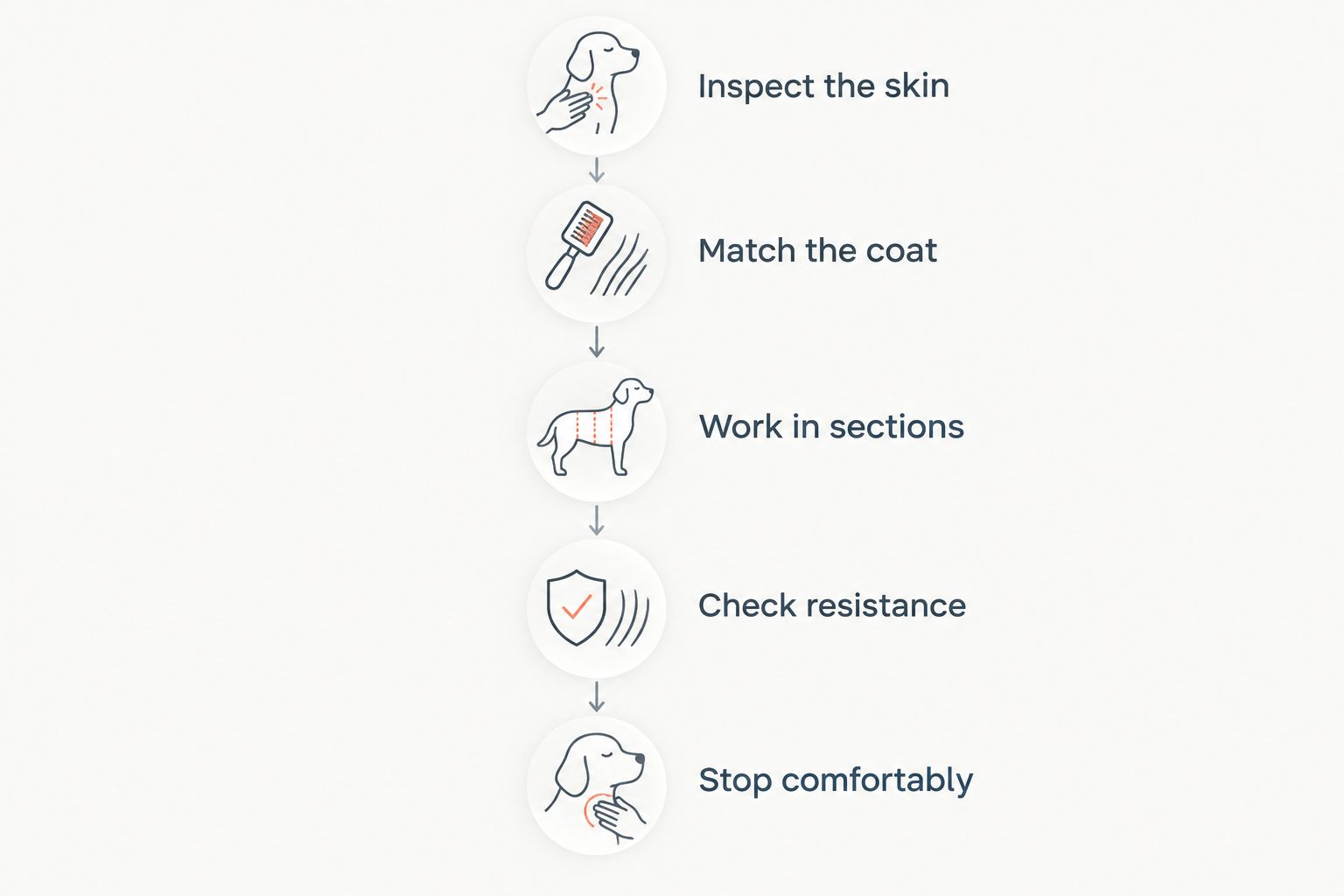
Loose shedding hair and compacted coat require different decisions. If you cannot separate the hair without pulling, compare mobile groomers for double-coated dogs rather than buying a sharper tool to force the issue.
How these tools are ranked
This 2026 ranking prioritizes coat access, noncutting construction, controlled handling, and a clear maintenance role. It compares tool types by their working action, not individual models through hands-on testing.
The rounded-pin rake takes the long-coat slot because its job matches loose undercoat removal. The rubber curry brush wins the short-coat slot; the comb earns a separate place because checking the result matters as much as collecting hair.
Which deshedding tool should you choose?
Choose a rounded-pin undercoat rake for a long, dense double coat, or a rubber curry brush for a short double coat. Add a metal comb when you need to check longer sections for remaining catches.
Do not buy every tool at once. Start with the tool that matches the coat, learn a comfortable technique, and add another only when it solves a distinct problem.
For your 2026 routine, treat mats, painful brushing, and irritated skin as reasons to change the plan. They are not evidence that you need a stronger deshedding tool.
FAQ
What's the best deshedding tool for dogs with long double coats?
A rounded-pin, noncutting undercoat rake is the default choice for loose undercoat in a long, dense double coat. Match the pin length to the coat and stop if the rake catches or pulls.
Is a rubber curry brush better than an undercoat rake?
A rubber curry brush is better suited to short coats, while an undercoat rake reaches into longer coats. Choose by coat length and access rather than treating either tool as universally better.
Can I use a deshedding tool every day?
Do not make daily deshedding the default. Frequency depends on the coat, shedding, skin condition, and tool; stop if brushing causes discomfort or irritation.
Can a deshedding tool remove mats?
A routine deshedding tool is not the right way to force through tight mats. Ask a groomer to assess compacted or matted coat, especially when it sits close to the skin.
Why does my dog still shed after brushing?
Brushing removes loose hair but does not stop the natural shedding cycle. More hair appearing afterward is not a reason to keep brushing the same area indefinitely.
Do double-coated dogs need to be shaved to reduce shedding?
Shaving is not a routine solution for shedding in a healthy double coat. Discuss severe matting or medical needs with a groomer and veterinarian rather than choosing shaving simply to reduce loose hair.
Does Fluffypetwash sell these deshedding tools?
Fluffypetwash is a mobile pet grooming service, not a tool recommendation presented as a store catalog. Use this guide to understand tool categories and decide whether home maintenance or professional grooming fits your needs.
One last thing
A smooth-looking outer coat can still hide tangles underneath. Before calling a section finished, part the hair and check it gently with a comb instead of judging only the surface.
That final check gives you a better stopping rule than the size of the fur pile: separated coat, comfortable skin, and no pulling.