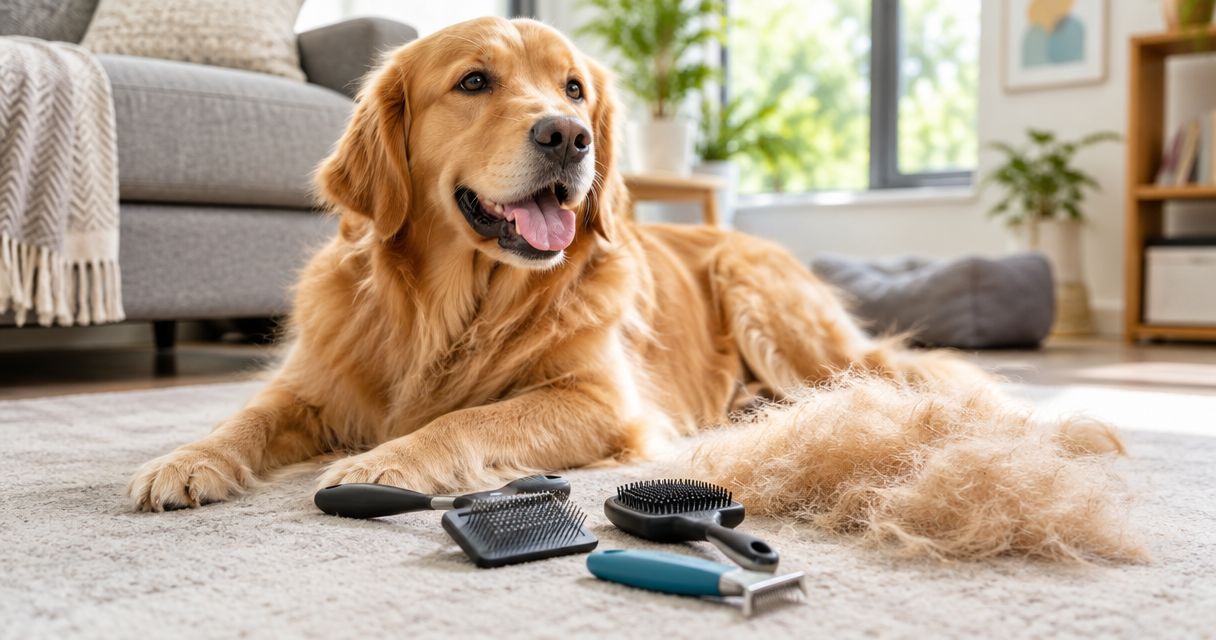
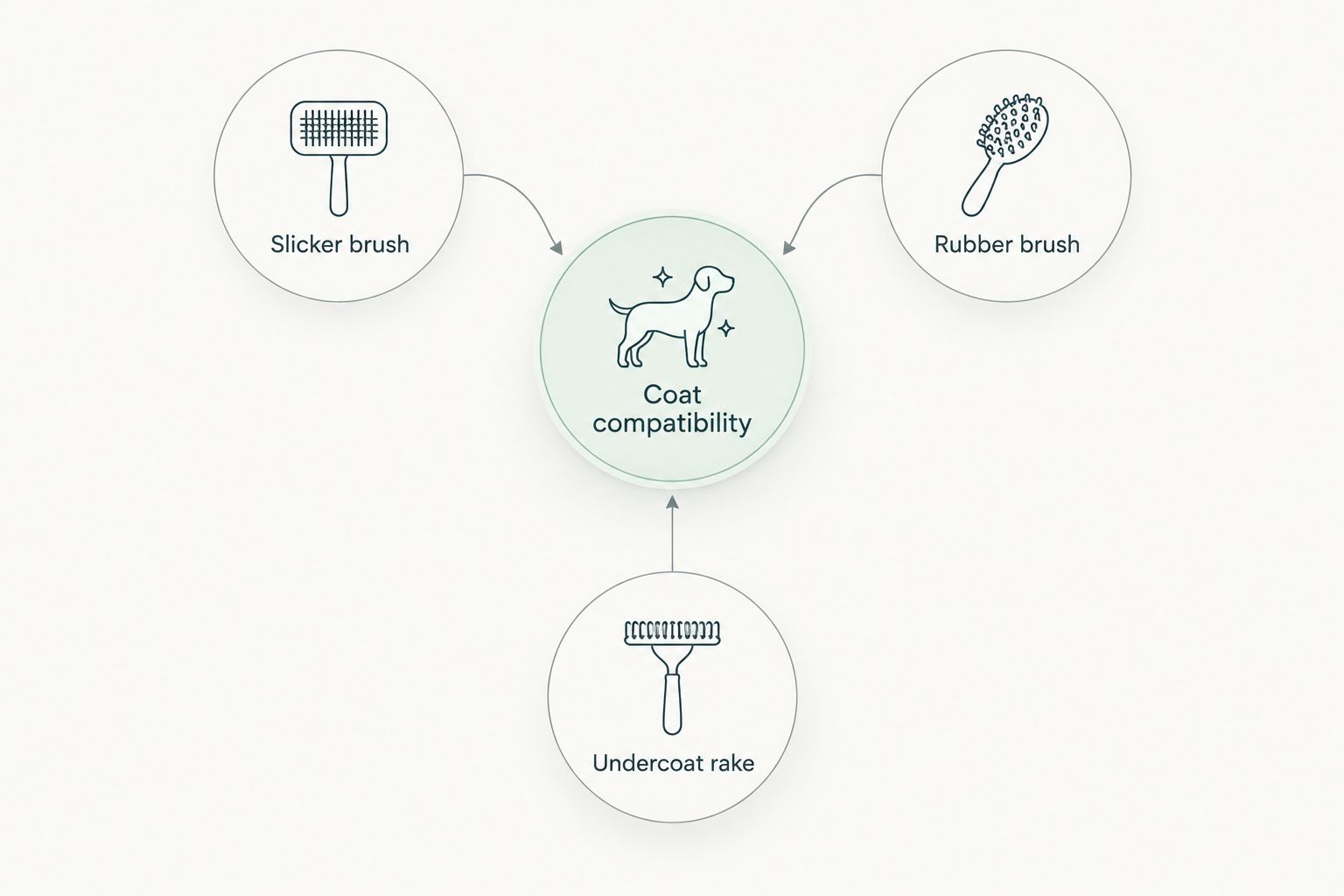
Best overall for loose hair in medium-to-long coats: a slicker brush. Best for short, smooth coats: a rubber grooming brush; best for dense double coats: an undercoat rake; best for finishing: a metal comb. This 2026 guide compares the best dog brush for shedding by coat type, including where each tool falls short.
- The best dog brush for shedding matches coat structure: slickers for longer coats, rubber brushes for short coats.
- Undercoat rakes target loose undercoat; metal combs check what brushing leaves behind.
- Stop brushing if skin reddens, the tool snags, or your dog shows discomfort.
- Fluffypetwash provides mobile pet grooming; professional grooming is a separate choice from buying a home brush.
Why this matters
A brush can collect loose fur without reaching the part of the coat that needs attention. A soft bristle brush, for example, works over the surface but does not replace an undercoat tool on a densely coated dog.
Start with your dog's coat, not the amount of hair on your couch. Brushing removes hair that has already loosened; it does not stop normal shedding.
Fluffypetwash is a mobile pet grooming service, not a brush manufacturer. This guide separates tools you can use at home from problems that need a groomer or veterinarian.
What makes the best dog brush for shedding?
For your 2026 shortlist, judge brushes against these criteria before choosing a handle shape or cleaning mechanism:
- Coat compatibility: The working surface must suit a smooth coat, longer outer coat, or dense undercoat.
- Skin comfort: Pins, teeth, or rubber fingers should move through the intended coat without scraping skin.
- Loose-hair access: A useful tool reaches loose hair rather than simply flattening the surface.
- Control: You should be able to guide the brush around shoulders, legs, and sensitive areas without pressing harder.
- Hair removal: Check how collected fur comes off the tool. A clogged brush becomes harder to use effectively.
- Limits: A shedding brush is not a treatment for skin disease or a safe solution for tight mats.
A double coat has 2 coat layers: an outer coat and an undercoat. Those layers explain why the brush that works on a smooth-coated dog does not automatically suit a densely coated dog.
Best shedding brushes at a glance
These are brush categories, not rankings of individual branded models. The right tooth length, spacing, and stiffness still depend on your dog's actual coat.
| Rank and brush | Best for | Standout feature | Key limitation |
|---|---|---|---|
| 1. Slicker brush | General brushing of medium-to-long coats | Fine, angled pins collect loose hair | Can scratch skin with excess pressure |
| 2. Rubber brush | Short, smooth coats | Flexible rubber fingers lift loose surface hair | Does not reach dense undercoat effectively |
| 3. Undercoat rake | Dense double coats | Spaced teeth reach into loose undercoat | Wrong tooth length or force causes pulling |
| 4. Metal comb | Checking longer coats after brushing | Teeth reveal remaining snags and loose hair | Slow for removing fur across large areas |
| 5. Bristle brush | Finishing fine, smooth coats | Bristles smooth the surface and collect light loose hair | Limited reach beneath a thick outer coat |
Choose the coat match first. A brush that gathers an impressive clump of hair is not necessarily the safest tool for repeated use on your dog.
1. Slicker brush: best shedding brush for medium-to-long coats
A slicker brush uses fine, angled pins to separate hair and collect loose fur. It is a useful starting tool for many medium-to-long coats, provided the pins suit the coat and you keep pressure light.
Work through small sections rather than repeatedly skimming the same surface. A slicker is not permission to brush through resistance: stop and inspect any snag before continuing.
Slicker brush pros:
- Collects loose hair while separating longer strands.
- Helps expose small tangles before they tighten.
- Works section by section on coats that need more than surface smoothing.
Slicker brush cons:
- Fine pins can irritate skin with repeated or forceful strokes.
- A short-pinned model can miss deeper coat despite leaving the surface tidy.
- Tight mats require a different approach, not harder brushing.
Best for: Dogs with medium-to-long coats that need routine loose-hair removal and gentle tangle management.
Verdict: Buy a slicker brush when its pins suit your dog's coat; skip it as a default for sensitive, short-coated skin.
2. Rubber brush: best shedding brush for short, smooth coats
A rubber grooming brush uses flexible fingers or nubs to lift loose hair from a short coat. It offers a different contact surface from metal pins and is a practical first choice when the coat lies close to the skin.
Follow the direction of hair growth and use gentle strokes. Some rubber tools are intended for bathing, but check the individual tool's instructions before using it wet.
Rubber brush pros:
- Lifts loose surface hair without metal pins.
- Suits close-lying coats that do not need deep tooth penetration.
- Gives you direct control over pressure across broad body areas.
Rubber brush cons:
- Does not separate long tangles.
- Cannot replace an undercoat rake for dense, loose undercoat.
- Friction still irritates skin if you rub repeatedly or press hard.
Best for: Short, smooth-coated dogs whose main grooming need is collecting loose surface hair.
Verdict: Buy a rubber brush for a smooth coat; skip it as the only tool for a thick double coat.
3. Undercoat rake: best shedding brush for dense double coats
An undercoat rake uses spaced teeth to reach loose hair beneath the outer coat. For this recommendation, choose a rake designed to separate and remove loose undercoat, rather than assuming every toothed deshedding tool works the same way.
Check whether the teeth reach the intended layer without dragging against skin. If the rake catches, do not pull through; inspect the section for tangles, packed coat, or debris.
Undercoat rake pros:
- Reaches loose undercoat that surface brushes leave behind.
- Lets you work through dense coat in controlled sections.
- Addresses a different grooming task from finishing the outer coat.
Undercoat rake cons:
- Unsuitable tooth length or spacing causes ineffective brushing or pulling.
- Does not safely resolve tight, skin-close mats.
- Repeated passes over the same area can irritate skin.
Best for: Double-coated dogs with loose undercoat and a coat condition suitable for home brushing.
Verdict: Buy an undercoat rake after confirming the tooth fit; hold if you cannot distinguish loose undercoat from matting.
4. Metal comb: best finishing tool after shedding-brush work
A metal grooming comb checks whether a brushed section is actually separated. Its teeth help you locate remaining snags and collect loose strands, especially in longer furnishings around the legs, chest, and tail.
Use the comb as a check, not a lever. If it stops, separate the hair gently and inspect the area instead of dragging the teeth toward the ends.
Metal comb pros:
- Reveals tangles hidden beneath a smooth-looking surface.
- Offers control in smaller areas.
- Helps check the result of slicker brushing.
Metal comb cons:
- Takes longer than a brush across broad areas.
- Pulls painfully if forced through a snag.
- Is not the most efficient primary tool for heavy loose undercoat.
Best for: Checking medium-to-long coats after brushing, especially where friction encourages tangles.
Verdict: Buy a metal comb as a finishing partner; skip it as your only heavy-shedding tool.
5. Bristle brush: best finishing brush for fine, smooth coats
A bristle brush smooths the coat's surface and gathers light loose hair. Its role is finishing, particularly when the coat does not require deep separation.
Do not confuse a glossy surface with a fully brushed coat. On a thick coat, bristles can pass over loose undercoat without removing it.
Bristle brush pros:
- Smooths surface hair after other grooming work.
- Collects light loose hair on suitable fine coats.
- Avoids the deep penetration of long metal teeth.
Bristle brush cons:
- Has limited reach into dense undercoat.
- Does not undo tangles or mats.
- Stiff bristles still require light pressure around sensitive skin.
Best for: Finishing a fine, smooth coat rather than tackling substantial undercoat shedding.
Verdict: Buy a bristle brush for finishing; skip it as the main solution for dense seasonal shedding.
How these brush types rank
The 2026 ranking prioritizes coat compatibility, loose-hair access, and control. The slicker takes the broad medium-to-long-coat slot; the other tools win distinct jobs rather than competing as interchangeable alternatives.
This is a comparison of 5 brush types, not a hands-on test of named retail products. Features such as retractable pins or a shaped handle do not outweigh the basic requirement: the working surface must suit your dog's coat.
How to brush without chasing every last hair
Use this 2026 routine to keep the task focused. The goal is comfortable coat maintenance, not making the brush come away completely empty.
Start with 3 checks
- Skin: Look for redness, sores, scabs, or irritated patches before brushing.
- Coat: Identify loose hair, small tangles, and tightly packed areas.
- Comfort: Notice whether your dog accepts gentle handling in the area you plan to brush.
Do not brush directly over injured or inflamed skin. Ask your veterinarian about skin changes, and ask a groomer about coat that is too tangled to separate comfortably.
Work in small sections
Begin where your dog tolerates handling. Follow hair growth, use light pressure, and clear collected fur from the tool as you work.
For longer coats, part the hair so you can see which section you are brushing. Surface-only strokes can leave tangles underneath while making the top look finished.
Stop at resistance
A snag is information, not an instruction to pull harder. Check whether the tool has caught a tangle, whether its teeth are unsuitable, or whether the section needs professional attention.
Stop if your dog flinches, repeatedly turns toward the brush, or tries to move away. Continuing through discomfort makes the session a handling problem as well as a coat problem.
Check the result
On a suitable longer coat, gently use a metal comb to find remaining snags. On a smooth coat, inspect the skin and look for loose surface hair without repeatedly rubbing the same patch.
For 2026 home grooming, choose a stopping point based on skin comfort and coat separation—not the total hair collected.
When a brush is not the next move
Sudden hair loss, bald patches, persistent itching, inflamed skin, and a strong change in skin odor belong with a veterinarian. Buying a more aggressive brush does not address those signs.
Tight mats, packed coat, and brushing that consistently causes distress need a different grooming plan. Fluffypetwash is a mobile pet grooming option for owners choosing professional help rather than more home tools; confirm the service fit for your dog before arranging care.
Fluffypetwash is for owners seeking mobile pet grooming, not a replacement for veterinary care when shedding accompanies skin changes.
Discuss your dog's grooming needs
Ask about mobile pet grooming and whether it suits your dog's coat and handling needs.
Which shedding brush should you choose?
Choose a slicker for a suitable medium-to-long coat, a rubber brush for a smooth coat, or an undercoat rake for loose double-coat undercoat. Add a metal comb when you need to check longer hair; choose bristles for finishing rather than deep removal.
If you remain undecided, get the coat identified before buying. A brush recommendation based only on breed name or visible shedding leaves out skin condition, tangles, and your dog's tolerance.
FAQ
What's the best dog brush for shedding?
The best dog brush for shedding depends on coat type: a slicker suits many medium-to-long coats, a rubber brush suits short smooth coats, and an undercoat rake targets loose double-coat undercoat. Match the tool to the coat rather than choosing by how much hair it collects.
Is a slicker brush better than a rubber brush?
A slicker is better for separating suitable medium-to-long coats, while a rubber brush is better suited to short, smooth coats. Neither is the best choice for every dog.
Will brushing stop my dog from shedding?
Brushing does not stop normal shedding. It removes loose hair from the coat before that hair falls elsewhere.
Can I brush my dog too much?
Yes, repeated brushing and excess pressure can irritate skin. Stop when skin reddens, the tool snags, or your dog shows discomfort instead of trying to collect every loose hair.
Should I use an undercoat rake on every dog?
No, an undercoat rake is intended for suitable coats with undercoat to remove. Short, smooth coats and tangled coats require a different tool choice or professional guidance.
Can a shedding brush remove mats?
A shedding brush is not a safe solution for tight mats. Pulling through compacted hair hurts and risks skin injury; ask a groomer to assess the coat.
When should I see a vet about shedding?
See a veterinarian when shedding comes with bald patches, persistent itching, sores, or inflamed skin. A grooming tool cannot diagnose or treat the cause of those changes.
One last thing
An empty brush is not proof of a finished coat, and a full brush is not proof of a good match. Some tools miss the loose layer; others keep collecting hair after the skin has had enough.
Keep your 2026 routine simple: identify the coat, use the matching tool gently, and stop before grooming becomes uncomfortable. If that remains difficult, discuss the coat and handling concerns with Fluffypetwash rather than buying increasingly aggressive tools.