Best overall: a fragrance-free, dog-specific shampoo. Best for dry, itchy skin without sores: a colloidal oatmeal formula. Best for a diagnosed skin condition: the medicated shampoo your veterinarian selects. This 2026 guide compares shampoo types by their purpose, limitations, and the skin history you should discuss before bathing.
- The best dog shampoo for sensitive skin is dog-specific and matched to the cause of irritation.
- Fragrance-free shampoo is the default for routine bathing; colloidal oatmeal is an option for dry, itchy skin.
- Medicated dog shampoo belongs in a veterinarian-directed plan, not a trial-and-error grooming routine.
- Tell Fluffypetwash about previous shampoo reactions before a mobile pet grooming appointment.
Why this matters
Sensitive skin describes a problem, not a diagnosis. Dryness, contact irritation, parasites, allergies, and infection require different responses; a shampoo that cleans the coat does not necessarily address the cause of scratching.
For owners booking Fluffypetwash mobile pet grooming, shampoo selection should start with the dog's skin history, not the scent. Share previous reactions and any veterinary bathing instructions before the appointment. A grooming visit is not a substitute for examining painful, inflamed, or persistently itchy skin.
For this 2026 guide, the recommendations are shampoo categories rather than named bottles. Choose by the current label and your dog's needs, rather than assuming every product carrying the same marketing term performs the same job.
What makes the best dog shampoo for sensitive skin?
Use these criteria before choosing a formula:
- Dog-specific labeling: Choose a product intended for dogs, with age restrictions and use instructions you can follow.
- Fragrance disclosure: For routine sensitive-skin bathing, favor a fragrance-free formula over one chosen to perfume the coat.
- Purpose that matches the problem: Separate ordinary cleansing, dry-skin support, puppy bathing, and prescribed treatment.
- Ingredient transparency: Read the full ingredient list, especially when your dog has reacted to a product before.
- Usable directions: Check dilution, application, rinsing, and any specified contact time. Instructions are product-specific.
- Known tolerance: A product your dog has previously tolerated is more useful evidence than a reassuring package claim.
Make 3 label checks before opening a new bottle: intended species and age, ingredients, and directions. Keep the packaging until you know how your dog responds; the product name alone will not give a veterinarian the full formulation.
Sensitive-skin dog shampoos at a glance
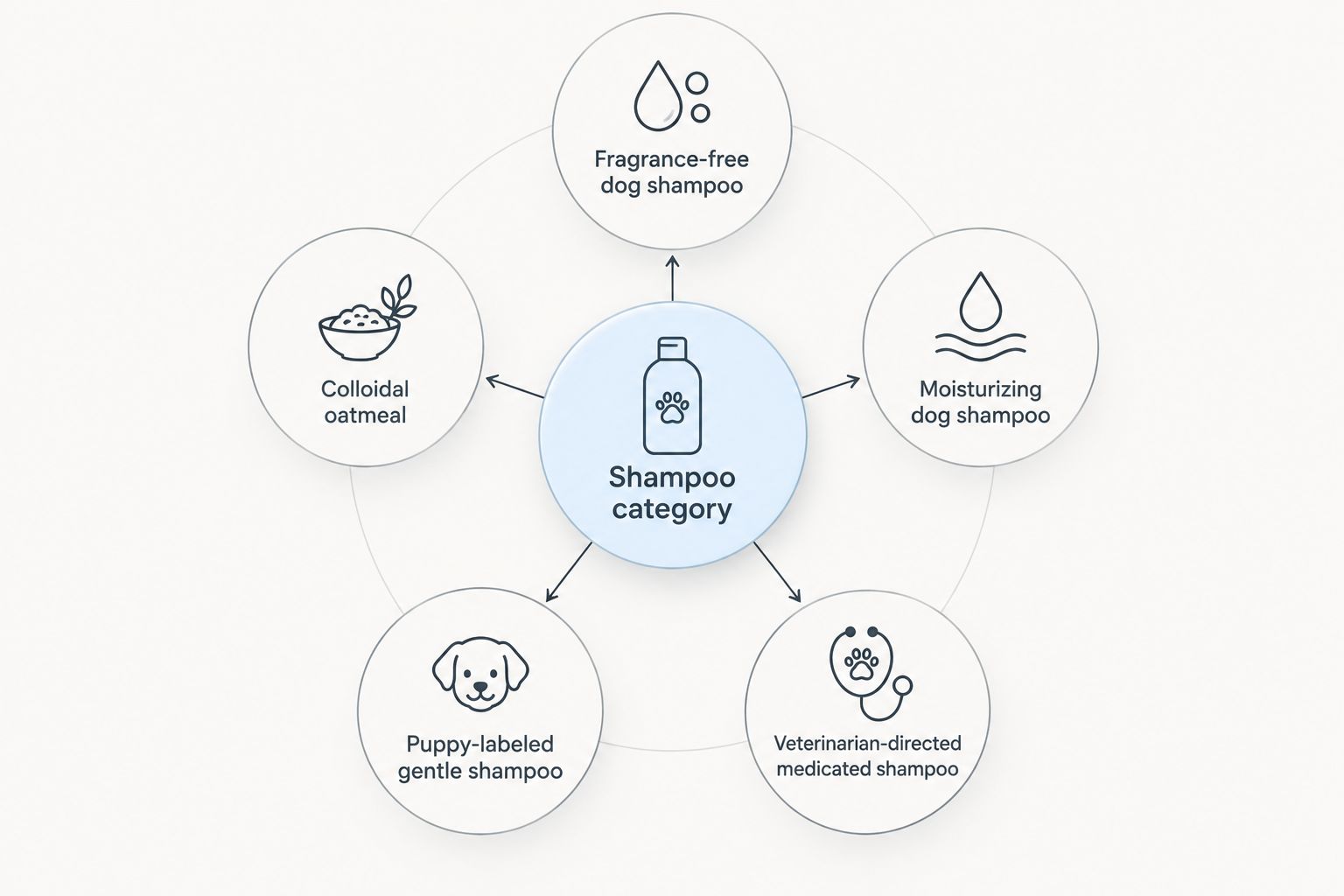
| Shampoo category | Best for | Standout feature | Key limitation |
|---|---|---|---|
| Fragrance-free dog shampoo | Routine cleansing when avoiding added scent | Cleansing without added fragrance | Does not diagnose or treat the cause of itching |
| Colloidal oatmeal dog shampoo | Dry, itchy skin without open sores | Oatmeal-based skin-soothing formulation | Not suitable for every dog or every skin condition |
| Moisturizing dog shampoo | Dry skin and coat needing conditioning | Conditioning ingredients alongside cleansing | Added ingredients require careful label review |
| Puppy-labeled gentle shampoo | Puppies needing an age-appropriate bath | Directions and restrictions intended for puppies | Puppy labeling does not guarantee individual tolerance |
| Veterinarian-directed medicated shampoo | A diagnosed condition requiring topical treatment | Active ingredients selected for a specific problem | Wrong selection or use can undermine treatment |
Treat these categories as a decision tree, not interchangeable upgrades. Start with the reason for bathing, then rule out formulas that do not fit your dog's age, reaction history, or veterinary instructions.
1. Fragrance-free: best dog shampoo for routine cleansing
A fragrance-free, dog-specific shampoo is the default when your dog needs cleaning and you want to avoid added perfume. It narrows one part of the ingredient decision without pretending to solve every cause of irritation.
For a routine bath in 2026, prioritize the full label over terms such as natural or premium. Fragrance-free describes one characteristic; it does not mean the formula contains no potential irritants.
Fragrance-free dog shampoo pros:
- Avoids added fragrance as a selection criterion.
- Fits ordinary cleansing without choosing a treatment product.
- Makes scent-free bathing preferences clear to your groomer.
Fragrance-free dog shampoo cons:
- Cleansing agents or other ingredients can still cause a reaction.
- Does not treat parasites, infection, or an underlying allergy.
Best for: Dogs needing routine cleaning whose owners want to avoid added scent.
Check whether the label says fragrance-free rather than relying on a mild smell. An unscented claim alone does not give you the full ingredient picture.
Verdict: Buy for routine cleansing when the label and your dog's history fit.
2. Colloidal oatmeal: best for dry, itchy skin without sores
Colloidal oatmeal appears in dog shampoos intended to soothe dry, itchy skin. Choose a dog-specific formula, and check what accompanies the oatmeal: fragrance, cleansing agents, and conditioning ingredients still matter.
An oatmeal label does not establish why your dog is scratching. Persistent itching, broken skin, or a known reaction to an ingredient calls for veterinary guidance rather than another experimental bath.
Colloidal oatmeal dog shampoo pros:
- Offers an option designed around soothing dry skin.
- Combines cleansing with a skin-comfort ingredient.
- Gives you a specific ingredient to discuss with your veterinarian.
Colloidal oatmeal dog shampoo cons:
- Does not replace treatment for infection or parasites.
- The complete formula can still contain ingredients your dog does not tolerate.
Best for: Dogs with dry, itchy skin when a veterinarian has not identified a reason to avoid the formula.
Do not use an oatmeal bath to postpone assessment of repeated scratching. Symptom relief and treatment of the cause are different goals.
Verdict: Hold until the formula fits your dog's skin history; skip it after a known ingredient reaction.
3. Moisturizing: best for dry skin needing conditioning
Moisturizing dog shampoos combine cleansing with ingredients intended to support skin and coat conditioning. This category fits a dryness-focused discussion, not an assumption that every itchy dog needs more oils.
Read the complete formula before choosing. A moisturizing claim says little about fragrance content, ingredient tolerance, or suitability for inflamed skin.
Moisturizing dog shampoo pros:
- Addresses conditioning alongside coat cleaning.
- Offers an alternative when ordinary cleansing leaves the coat feeling dry.
- Can fit a veterinarian-approved dry-skin bathing routine.
Moisturizing dog shampoo cons:
- Additional ingredients create more labels to assess after a previous reaction.
- Conditioning does not establish or correct the underlying cause of dryness.
Best for: Dogs whose bathing plan specifically calls for skin and coat conditioning.
Avoid adding household oils or mixing products to create your own formula. Use the shampoo as labeled, and ask whether a separate conditioner belongs in the routine before adding one.
Verdict: Buy when conditioning is the identified need; skip when you are guessing at the cause of irritation.
4. Puppy-labeled gentle shampoo: best for age-specific bathing
A puppy-labeled dog shampoo is the relevant starting point when age restrictions determine what you can use. Read the minimum-age instructions rather than assuming all gentle shampoos suit all puppies.
Puppies with redness, scabs, hair loss, or repeated scratching need veterinary assessment. A gentle label is not permission to wash away an unexplained skin problem.
Puppy-labeled shampoo pros:
- Provides age-related directions to check before bathing.
- Keeps the selection focused on puppy use rather than adult coat claims.
- Helps you identify restrictions before the appointment.
Puppy-labeled shampoo cons:
- Does not guarantee the absence of irritating ingredients.
- Tearless wording does not make deliberate eye exposure acceptable.
Best for: Puppies whose age and skin condition match the product's directions.
For a puppy's first grooming discussion in 2026, bring the age, previous bathing history, and any veterinary instructions. Keep shampoo out of the eyes and ear canals, regardless of the front-label wording.
Verdict: Buy only when the puppy meets the label's age requirements and has no unresolved skin concern.
5. Veterinarian-directed medicated shampoo: best for diagnosed conditions
Medicated shampoos contain active ingredients intended for particular skin problems. A veterinarian should select the treatment when examination or testing is needed to distinguish infection, parasites, allergy, and other causes.
More active ingredients do not make a shampoo a better routine cleanser. The diagnosis, concentration, application instructions, and bathing schedule determine its role.
Veterinarian-directed medicated shampoo pros:
- Matches topical treatment to an identified problem.
- Provides a defined application plan rather than cosmetic guesswork.
- Can form part of a broader veterinary treatment routine.
Veterinarian-directed medicated shampoo cons:
- The wrong active ingredient will not address every cause of itching.
- Treatment requires attention to product-specific directions and follow-up.
Best for: Dogs with a diagnosed condition for which a veterinarian recommends topical treatment.
Tell your groomer about the treatment before booking. Confirm whether the appointment can follow the veterinarian's instructions; do not assume a grooming service uses, supplies, or administers a particular medicated product.
Verdict: Wait for veterinary direction before choosing a medicated shampoo.
How these shampoo categories are ranked
The ranking prioritizes appropriate routine cleansing before specialized conditioning or treatment. Fragrance-free dog shampoo comes first because it answers the ordinary bathing question without treating all sensitive skin as a medical diagnosis.
The remaining slots serve distinct needs: dry-skin soothing, conditioning, puppy age restrictions, and diagnosed disease. This is a selection framework, not a claim of laboratory testing or a head-to-head trial of named products.
For your 2026 shortlist, a prior reaction or veterinary instruction overrides the order. The right category for your dog matters more than its position in a list.
Before the bath: give your groomer the useful details
Share 4 details before a sensitive-skin appointment: the exact previous product, the reaction you noticed, when it appeared, and any current veterinary instructions. A photograph of the label helps distinguish formulas with similar names.
When contacting Fluffypetwash, ask which shampoo is proposed and explain any known restrictions. Confirm product suitability before the bath rather than relying on a general request for something gentle.
Think about bathing in 2 stages: preparation and follow-through. Preparation means selecting an appropriate product and following its directions; follow-through means thorough rinsing and watching for a change in comfort afterward.
- Use the label's dilution and application instructions.
- Use comfortably lukewarm water rather than hot water.
- Rinse carefully, including areas where lather collects.
- Avoid rubbing inflamed skin aggressively with a towel.
- Contact your veterinarian if irritation develops or worsens.
Do not set a universal bathing interval from a ranked guide. Coat needs, skin conditions, and prescribed treatments change the schedule.
Which sensitive-skin dog shampoo should you choose?
Choose a fragrance-free, dog-specific shampoo for routine cleansing when your dog has no unresolved skin symptoms. Choose colloidal oatmeal or a moisturizing formula only when that purpose fits the skin history; use puppy labeling to check age suitability.
If your dog has persistent itching, pain, sores, discharge, or a recurring unusual odor, choose veterinary assessment before another shampoo. Medicated bathing belongs to the resulting treatment plan, not a stronger-is-better shopping decision.
For a Fluffypetwash appointment in 2026, make the shampoo conversation part of booking. Product selection and clear instructions matter more than leaving the appointment smelling perfumed.
FAQ
What's the best dog shampoo for sensitive skin?
A fragrance-free, dog-specific shampoo is the default for routine cleansing when your dog has no unresolved skin symptoms. Dryness, puppy age restrictions, or a diagnosed condition can change that choice.
Is oatmeal shampoo better than fragrance-free shampoo?
Neither label automatically makes a shampoo better for every dog. Oatmeal describes an ingredient, while fragrance-free describes the absence of added fragrance; a formula can meet both descriptions.
Can I use baby shampoo on a dog with sensitive skin?
Choose a dog-specific shampoo rather than substituting human baby shampoo. A human product's gentle labeling does not establish its suitability for your dog's skin or bathing needs.
How often should I bathe a dog with sensitive skin?
Use a bathing schedule matched to your dog's skin condition and the product instructions. Follow your veterinarian's schedule for treatment rather than adopting a universal interval from a buying guide.
Does hypoallergenic dog shampoo guarantee no reaction?
No, a hypoallergenic claim does not guarantee that your dog will tolerate a shampoo. Read the complete ingredient list and avoid ingredients associated with a previous reaction.
When should I stop trying different dog shampoos?
Stop experimenting when itching persists, symptoms worsen, or the skin becomes painful, broken, or inflamed. A veterinarian should assess the cause before you introduce another formula.
What should I tell a mobile groomer about sensitive skin?
Provide previous product names, reaction details, and current veterinary instructions before the appointment. Ask which shampoo is proposed and confirm whether the requested bathing instructions can be followed.
One last thing
Photograph the back of the bottle, not just the front. The ingredient list and directions are more useful for investigating a reaction than the words sensitive skin in large print. Keep that photograph with your dog's grooming notes so the next product decision starts with evidence.